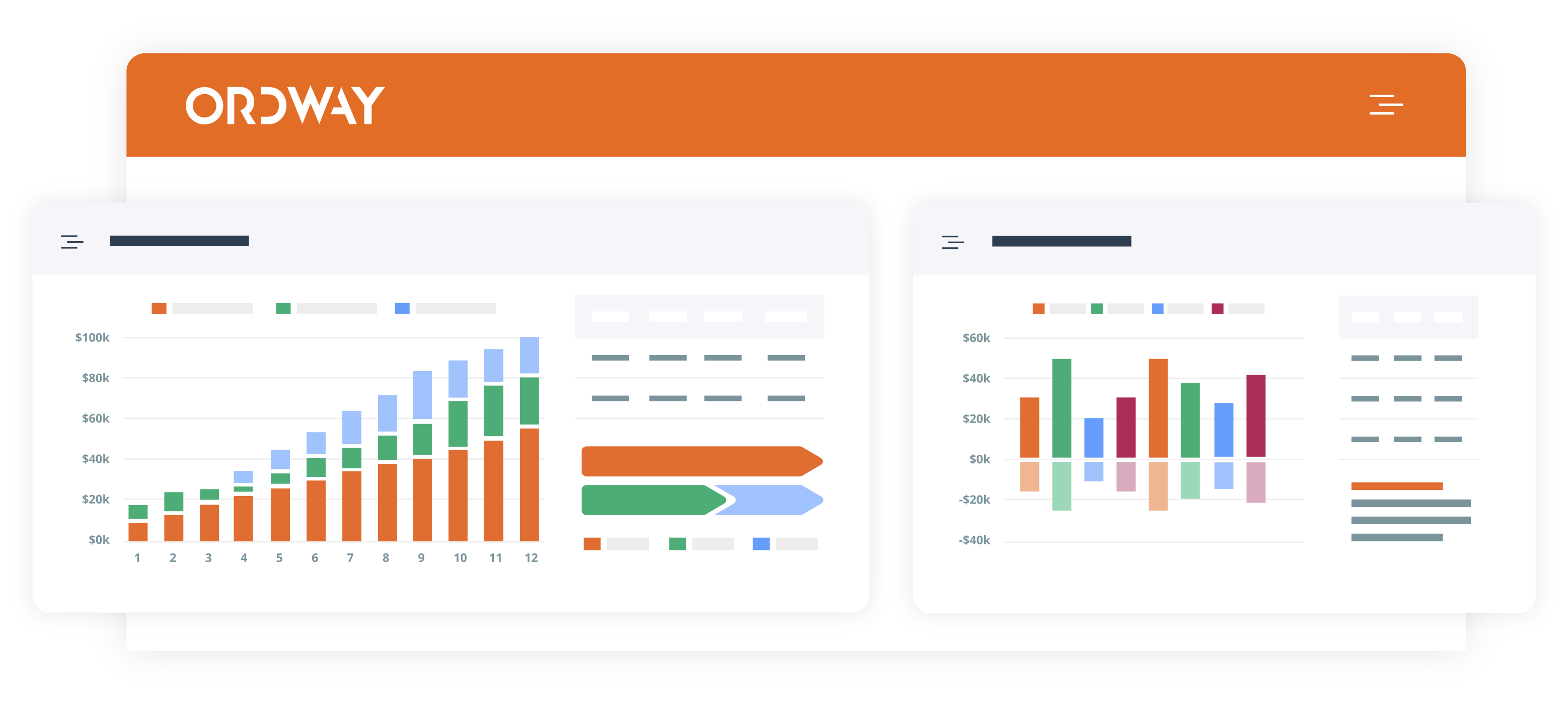
Usage-based billing software automates the process of charging customers based on actual consumption—API calls, compute hours, transactions, or data volume—rather than fixed subscription fees. The platform handles metering, applies pricing rules through a rating engine, generates detailed invoices, and posts revenue entries to your general ledger.
For growing SaaS and cloud businesses, this category of software replaces the spreadsheet-driven calculations that break down as transaction volumes scale. This guide covers the core features, pricing models, advanced billing constructs, and integration requirements that finance teams evaluate when selecting a usage-based billing platform.
What Is Usage-Based Billing Software
What is usage-based billing software and why do growing businesses adopt it?
Usage-based billing software automates invoicing by tracking actual consumption metrics like API calls, data volume, or active compute hours. Instead of charging customers a flat monthly fee, the platform meters real usage, applies pricing rules through a rating engine, and generates accurate invoices automatically.
For SaaS and cloud businesses, this approach ties costs directly to the value customers receive. A customer processing 10,000 API requests pays differently than one processing 100,000, and the billing system handles that calculation without spreadsheets or manual intervention.
The core components of usage-based billing software work together in a continuous cycle:
- Metering: Capturing and recording usage events as they occur
- Rating engine: Applying pricing rules to convert raw usage into billable amounts
- Invoice generation: Producing detailed bills with usage breakdowns and balance information
- Revenue recognition: Creating compliant revenue schedules under ASC 606 or IFRS 15
How Usage-Based Billing Software Works
How does usage-based billing software transform raw usage data into accurate invoices?
The process flows through five distinct stages, with each stage building on the previous one. Understanding this workflow clarifies why purpose-built software replaces manual processes as companies scale.
Step 1: Usage data ingestion
Usage events enter the billing system through streaming APIs, batch uploads, or CSV file imports. A cloud infrastructure provider might stream millions of compute-second events daily, while a smaller SaaS company might upload transaction counts weekly.
Step 2: Data mediation and validation
Raw usage records often contain duplicates, formatting inconsistencies, or missing fields. The mediation layer normalizes this data, flags anomalies, and prepares clean records for pricing calculations. This step catches billing errors before they reach customers.
Step 3: Rating engine applies pricing rules
The rating engine takes validated usage and applies your pricing logic. If a customer consumed 50,000 API calls at $0.001 per call, the engine calculates $50.00. For tiered pricing, it determines which rates apply to which usage bands.
Step 4: Invoice generation with usage details
The platform produces invoices showing exactly how charges were calculated, including usage quantities, applicable rates, tier breakdowns, and any credits or adjustments.
Step 5: Revenue recognition and GL posting
Finally, the system generates revenue schedules compliant with ASC 606 or IFRS 15 and posts journal entries to connected accounting systems like QuickBooks, Xero, Sage Intacct, or NetSuite.
Core Features of Usage-Based Billing Software
What features does every usage-based billing platform include?
Certain capabilities form the foundation of any consumption-based billing system. Without these features, companies typically resort to spreadsheets and manual calculations that break down as transaction volumes grow.
Usage metering and data ingestion
The platform captures consumption data from your product, infrastructure, or third-party services. High-volume businesses often use streaming APIs that process events in real time, while others prefer scheduled batch uploads. Reliable metering determines everything downstream—if usage data is incomplete or delayed, invoices will be wrong.
Data mediation and validation
Before pricing calculations begin, the system normalizes incoming records by deduplicating events, validating required fields, and converting units into consistent formats. A well-designed mediation layer catches problems early, flagging a sudden 10x spike in usage that might indicate a data error rather than genuine consumption.
Flexible rating engine
The rating engine sits at the heart of usage-based billing. It applies your pricing rules to metered usage and supports multiple rate structures:
- Single-rate pricing: One price per unit regardless of volume (e.g., $0.01 per API call)
- Volume pricing: The rate per unit decreases as total consumption increases, applied retroactively to all usage
- Tiered pricing: Different rates apply to different usage bands (first 10,000 calls at $0.01, next 50,000 at $0.008)
- Stair-step pricing: A flat fee based on which usage tier the customer reaches
Automated invoice generation
Invoices display the rating formulas, usage quantities, and balance information that customers use to understand their charges. Transparent invoices reduce the back-and-forth that consumes finance team time.
Prepaid credits and balance management
Many usage-based models involve customers purchasing credits upfront, then drawing down against actual consumption. The billing system tracks balances in real time, triggers replenishment alerts, and handles pooling across products or business units.
Overages, minimums, and true-ups
Enterprise contracts often include minimum commitments, usage allowances, and overage rates. The software calculates what happens when customers exceed their included usage, enforces minimum spend requirements, and reconciles actual versus committed usage at period end.
Pricing Models Supported by Usage-Based Billing Platforms
What pricing models can usage-based billing software handle?
Modern platforms support multiple pricing structures simultaneously, often on the same invoice. A customer might pay a base subscription fee plus per-transaction charges plus overage fees, all calculated automatically.
| Pricing Model | How It Works | Best For |
|---|---|---|
| Pay-as-you-go | Charge per unit consumed | Variable, unpredictable usage patterns |
| Tiered | Different rates per usage band | Encouraging higher consumption |
| Volume | Discounted rate based on total usage | Rewarding high-volume customers |
| Stair-step | Flat fee per usage bracket | Simplified customer billing |
| Hybrid | Subscription base + usage fees | Predictable revenue with flexibility |
Pay-as-you-go pricing
Customers pay only for what they consume with no minimum commitment. This model lowers the barrier to entry, allowing a startup to begin using your service for a few dollars and scale spending as their own business grows.
Tiered pricing
Different rate tiers apply to different usage bands. For example, the first 10,000 transactions might cost $0.05 each, while transactions 10,001 through 50,000 cost $0.04 each.
The calculation follows this pattern:
Tiered Pricing Formula: (Units in Tier 1 × Rate 1) + (Units in Tier 2 × Rate 2) + …
If a customer uses 25,000 transactions: (10,000 × $0.05) + (15,000 × $0.04) = $500 + $600 = $1,100
Volume pricing
Unlike tiered pricing, volume pricing applies a single rate retroactively to all usage once a threshold is reached. If crossing 50,000 units drops the rate from $0.05 to $0.04, the customer pays $0.04 for every unit—not just those above 50,000.
Hybrid subscription and usage pricing
Many SaaS companies combine a fixed subscription base with variable usage charges. A customer might pay $500 per month for platform access plus $0.01 per API call. This hybrid approach provides revenue predictability while capturing value from heavy users.
Advanced Billing Constructs for Enterprise Contracts
What complex commercial arrangements can usage-based billing software support?
Enterprise deals often include terms that go well beyond simple per-unit pricing. The billing platform handles these constructs automatically, eliminating the spreadsheet work that finance teams otherwise perform manually.
Prepaid credit pools and drawdowns
Customers purchase credits upfront—say, $100,000 annually—that are drawn down as usage occurs. The system tracks remaining balances, calculates consumption against the pool, and handles what happens when credits run out. Some contracts allow pooling credits across products, departments, or subsidiary companies.
Rollovers and allowances
Subscription plans often include usage allowances, perhaps 50,000 API calls per month. Unused allowances might roll over to future periods or expire. The billing system tracks these balances and applies them correctly before calculating overage charges.
Monthly minimums and annual spend commitments
A customer might commit to $10,000 per month minimum spend or $100,000 annually through a capacity contract. If actual usage falls short, they still pay the committed amount. These arrangements provide revenue predictability while giving customers flexibility in how they consume.
Automated true-up calculations
At the end of a contract period, the system reconciles actual usage against commitments. If a customer committed to $120,000 annually but only consumed $95,000, the true-up calculation determines the $25,000 shortfall automatically.
Benefits of Usage-Based Billing Software
Why do growing SaaS and cloud businesses adopt usage-based billing software?
The advantages extend beyond automating invoice calculations. Companies that implement purpose-built billing platforms often see improvements across multiple dimensions:
- Faster pricing experimentation: Launch new pricing models without waiting for billing system upgrades or custom development
- Reduced billing errors: Automated calculations eliminate manual spreadsheet mistakes that create customer disputes
- Improved customer transparency: Detailed invoices showing exactly how charges were calculated reduce support inquiries
- Built-in expansion revenue: Customers naturally pay more as their usage grows, without requiring sales intervention
- Compliance readiness: Integrated revenue recognition supports ASC 606 and IFRS 15 requirements
Integrations Every Usage-Based Billing Platform Includes
What systems does usage-based billing software connect with?
Billing operates at the center of the quote-to-cash process, which means it touches nearly every other business system. Pre-built integrations reduce implementation time and ongoing maintenance.
CRM and CPQ systems
Contract data flows from Salesforce or HubSpot into the billing platform. Billing data—usage trends, expansion opportunities, renewal dates—flows back to inform sales and customer success activities.
Payment gateways
Connections to Stripe and other processors enable auto-pay, ACH transfers, and credit card collection. When an invoice is generated, payment collection can happen automatically.
Tax engines
Integration with Avalara or Anrok calculates sales tax, VAT, or other levies across jurisdictions. Usage-based invoices often span multiple tax regions, making automated calculation essential.
Accounting and ERP systems
The billing platform posts journal entries to QuickBooks, Xero, Sage Intacct, or NetSuite. This automation keeps AR balances, revenue schedules, and cash accounts synchronized without manual data entry.
Automate Usage-Based Billing with Ordway
Ordway’s usage-based billing platform handles the full lifecycle of consumption-based monetization, from metering through invoicing and collection. The flexible rating engine supports single-rate, volume, tiered, and stair-step pricing, plus hybrid models combining subscriptions, percentage billing, and one-time charges. Advanced constructs like prepaid credits, capacity contracts, and automated true-ups work out of the box, with transparent invoices that expose rating formulas and balance details.
Frequently Asked Questions About Usage-Based Billing Software
How does usage-based billing software differ from subscription billing software?
Subscription billing charges fixed recurring fees on a predictable schedule. Usage-based billing charges based on actual consumption, which varies month to month. Many platforms, including Ordway, support both models in hybrid arrangements where customers pay a base subscription plus variable usage fees.
What data sources can usage-based billing software ingest?
Platforms typically accept streaming API events for real-time metering, batch file uploads for periodic data, and CSV imports for manual or legacy data sources. The specific connectors vary by vendor, so verify compatibility with your product infrastructure during evaluation.
How long does implementation typically take?
Timelines vary based on pricing complexity, integration requirements, and data migration scope. Simple implementations with straightforward pricing might complete in a few weeks, while complex enterprise deployments with multiple integrations and historical data migration often take two to three months.
Frequently Asked Questions
Usage-based billing software automates invoicing by tracking actual consumption metrics like API calls, data volume, or compute hours, then applies pricing rules through a rating engine to generate accurate invoices. Instead of charging a flat monthly fee, customers pay based on what they actually use.
Usage-based billing ties costs directly to the value customers receive and eliminates spreadsheet-driven calculations that break down as transaction volumes scale. A customer processing 10,000 API requests pays differently than one processing 100,000, and the system handles that automatically.
The platform handles metering of consumption, applies pricing rules through a rating engine, generates detailed invoices, and posts revenue entries to your general ledger automatically.
Growing SaaS and cloud businesses that charge customers based on consumption rather than fixed subscriptions need this software to replace manual, spreadsheet-driven billing processes.