Revenue recognition software automates one of the most audit-sensitive processes in finance, yet many companies buy it the same way they’d buy any SaaS tool: a few demos, a pricing comparison, and a signature. That approach works fine for expense management. It fails for a system that directly impacts your financial statements and investor reporting.
The procurement process for revenue recognition software requires input from accounting, IT, and operations, plus a clear understanding of how the platform handles ASC 606 compliance, contract modifications, and integration with your existing stack. This guide covers the evaluation criteria, vendor questions, and implementation considerations that separate successful purchases from expensive mistakes.
What is revenue recognition software
What is revenue recognition software and why does it matter for SaaS companies?
Revenue recognition software automates the process of tracking when and how revenue appears on financial statements, following accounting standards like ASC 606 and IFRS 15. Choosing the right platform requires a clear plan: map your contract data, test compliance with accounting standards, and verify how well the tool connects to your billing and ERP systems. A careful buying process prevents costly mistakes later.
At its core, the software implements the five-step model required by ASC 606: identify the contract, identify performance obligations, determine the transaction price, allocate the price to obligations, and recognize revenue as obligations are satisfied. For subscription and usage-based businesses, this process repeats across hundreds or thousands of contracts each month.
The alternative is spreadsheets. And while spreadsheets work fine when you have 50 contracts, they become error-prone and time-consuming as contract volume grows. Revenue recognition software applies your accounting policies automatically, generates the journal entries, and maintains the audit trail that auditors expect.
Why finance teams automate revenue recognition
Why are finance teams moving away from manual revenue recognition processes?
Manual revenue recognition creates bottlenecks that compound as companies scale. When contract volume doubles, the spreadsheet workload more than doubles, and so does the risk of errors that auditors will flag.
The business drivers for automation typically include:
- Faster close cycles: Automated revenue schedules eliminate the manual journal entry work that extends month-end close by days
- Audit readiness: Every schedule change, policy application, and journal entry is logged with a complete audit trail
- Scalability: The system handles contract growth without adding headcount to the accounting team
- Compliance confidence: Built-in ASC 606/IFRS 15 logic reduces the risk of misapplied policies
Finance teams that automate revenue recognition often reduce their close timeline significantly, freeing capacity for analysis rather than data entry.
Signs you need dedicated revenue recognition software
How do you know when it’s time to invest in revenue recognition software?
Several diagnostic triggers signal that spreadsheet-based processes have reached their limits. Recognizing these early helps avoid the scramble that comes when auditors or investors start asking harder questions.
Spreadsheets are delaying the monthly close
When the accounting team spends multiple days each month building and reconciling revenue schedules, the close timeline stretches. Formula errors, version control issues, and manual journal entries create bottlenecks that dedicated software eliminates.
Contract complexity is growing with bundles and usage
Multi-element arrangements require stand-alone selling price (SSP) allocation across bundled performance obligations. SSP allocation is the process of distributing a contract’s total price across each distinct deliverable based on what each would sell for separately. Usage-based pricing adds another layer of complexity. Spreadsheets struggle to handle these calculations consistently across hundreds of contracts.
Audit findings and investor scrutiny are increasing
Auditor comments about revenue recognition policies or investor due diligence requests for detailed revenue schedules signal the need for systematic controls. A dedicated system provides the documentation and audit trails that satisfy these requirements.
Multi-entity and multi-currency operations are expanding
International expansion introduces foreign exchange conversion, intercompany transactions, and potentially dual GAAP reporting. Managing these manually across multiple legal entities creates consolidation complexity that purpose-built software handles automatically.
Core capabilities to require in revenue recognition software
What features does revenue recognition software need to include?
The requirements checklist for procurement centers on capabilities that directly support ASC 606/IFRS 15 compliance and operational efficiency.
ASC 606 and IFRS 15 compliance support
The software automates all five steps of the revenue recognition model: contract identification, performance obligation identification, transaction price determination, price allocation, and recognition timing. Without this foundation, you’re still doing the hard work manually.
Revenue subledger with full audit trail
A revenue subledger is a dedicated ledger that tracks recognized versus deferred revenue by contract, separate from the general ledger. Every schedule change, journal entry, and policy application is logged. Auditors expect this level of documentation.
Flexible recognition models and contract modifications
Different revenue streams require different recognition methods:
- Straight-line: Equal recognition over the contract term
- Exact days: Daily proration based on actual days in each period
- Point-in-time: Recognition at delivery, milestone completion, or end-of-term
- Usage-based: Recognition tied to consumption data
Contract modifications, including amendments, renewals, and cancellations, automatically recalculate schedules without manual intervention.
Stand-alone selling price allocation for bundles
SSP allocation distributes the transaction price across bundled performance obligations. The software applies observable prices or estimation methods such as adjusted market assessment, expected cost plus margin, or residual approach.
Multi-entity, multi-currency, and multi-GAAP support
Global operations require handling multiple legal entities, currencies with FX conversion, and potentially dual reporting under US GAAP and IFRS. Verify these capabilities before shortlisting vendors.
Native integrations with CRM, billing, and GL
Pre-built integrations with your existing stack eliminate custom development for core workflows. Poor integration creates manual workarounds that defeat the purpose of automation.
Procurement process for revenue recognition software
What steps do finance teams follow when procuring revenue recognition software?
A structured procurement process reduces the risk of selecting a platform that doesn’t fit your requirements. The following workflow reflects how successful implementations typically begin.
Step 1. Assemble the buying committee
Identify stakeholders: the Controller or CAO owns accounting policy, the CFO holds budget authority, IT evaluates integration requirements, RevOps manages contract data, and external auditors provide compliance input. Missing any of these perspectives creates blind spots.
Step 2. Document current state requirements
Catalog existing revenue recognition policies, pain points, contract types, pricing models, and integration touchpoints. Create a requirements matrix weighted by priority. This becomes your evaluation scorecard.
Step 3. Issue an RFI and shortlist vendors
A Request for Information (RFI) is a preliminary questionnaire that gathers vendor capabilities. Use responses to create a shortlist of three to five vendors that meet baseline requirements before investing time in detailed demos.
Step 4. Run scripted demos and a proof of concept
Develop demo scripts using actual contract scenarios: bundles, modifications, usage-based pricing. For finalists, conduct a proof of concept (POC) with real data to validate configuration and integration before signing.
Step 5. Negotiate contract terms and SLAs
Negotiate pricing, implementation support, training, SLAs for uptime and support response, and terms for future price increases. Include exit provisions and data portability. You want flexibility if circumstances change.
Evaluation criteria for vendor selection
How do you compare revenue recognition software vendors?
Once you’ve shortlisted vendors, apply consistent evaluation criteria to make an objective selection. The following factors separate platforms that look good in demos from those that perform in production.
| Criterion | What to Evaluate | Red Flags |
|---|---|---|
| ASC 606 depth | Full automation of all five steps | Manual workarounds for variable consideration or contract combinations |
| Scalability | Performance at 2-3x current contract volume | Architecture changes required for growth |
| Security | SOC 2 Type II certification | No third-party security audits |
| Vendor stability | Funding, customer base, product roadmap | Limited investment in ongoing compliance updates |
| References | Customers with similar business models | No references in your segment |
Request references from companies with similar pricing models and similar scale. Ask about implementation experience and ongoing support quality.
Questions to ask vendors during demos
What questions reveal whether a vendor can actually meet your requirements?
Demos show ideal scenarios. The following questions expose gaps that matter in production.
Compliance and accounting policy questions:
- How does your system handle the five-step ASC 606 model?
- Can we configure multiple revenue recognition policies by product line?
- How are contract modifications handled?
- What audit trail and reporting is available for auditors?
Integration and data model questions:
- What pre-built integrations exist for our CRM, billing system, and GL?
- How is contract data ingested: API, file upload, or manual entry?
- What is the latency between contract changes and revenue schedule updates?
Implementation and pricing questions:
- What is the typical implementation timeline for companies like ours?
- How is pricing structured: per contract, per user, or flat fee?
- What are the terms for annual price increases?
Total cost of ownership and ROI
What costs factor into total cost of ownership for revenue recognition software?
Software licensing is only part of the investment. A complete TCO analysis includes:
- Software licensing: Subscription fees based on contracts, users, or revenue
- Implementation services: Configuration, data migration, training
- Ongoing maintenance: Annual support, upgrades, additional integrations
- Internal labor: Staff time for implementation and ongoing administration
The ROI drivers include reduced close time, headcount avoidance, lower audit fees, and reduced restatement risk.
ROI Formula:
ROI = (Annual Savings – Annual Software Cost) / Annual Software Cost
Worked Example:
If annual savings from faster close and headcount avoidance equal $150,000 and annual software cost is $50,000:
ROI = ($150,000 – $50,000) / $50,000 = 2.0 or 200%
Common procurement mistakes to avoid
What mistakes do finance teams commonly make when buying revenue recognition software?
Even experienced teams fall into predictable traps. Awareness helps you avoid them.
Prioritizing price over ASC 606 depth
The cheapest option often requires manual workarounds for complex scenarios, negating the automation benefit. Evaluate total cost of ownership, not just licensing fees.
Skipping the proof of concept
Demos use clean sample data. A POC with your actual contracts reveals configuration gaps and integration issues before you’ve signed a multi-year agreement.
Underestimating implementation effort
Revenue recognition software requires policy decisions, historical data migration, and cross-functional coordination. Budget adequate time and resources. Implementations typically take 8-16 weeks for mid-market companies.
Ignoring non-finance stakeholders
Sales, RevOps, and IT own the contract data and system integrations that determine success. Their participation isn’t optional.
Automating revenue recognition with Ordway
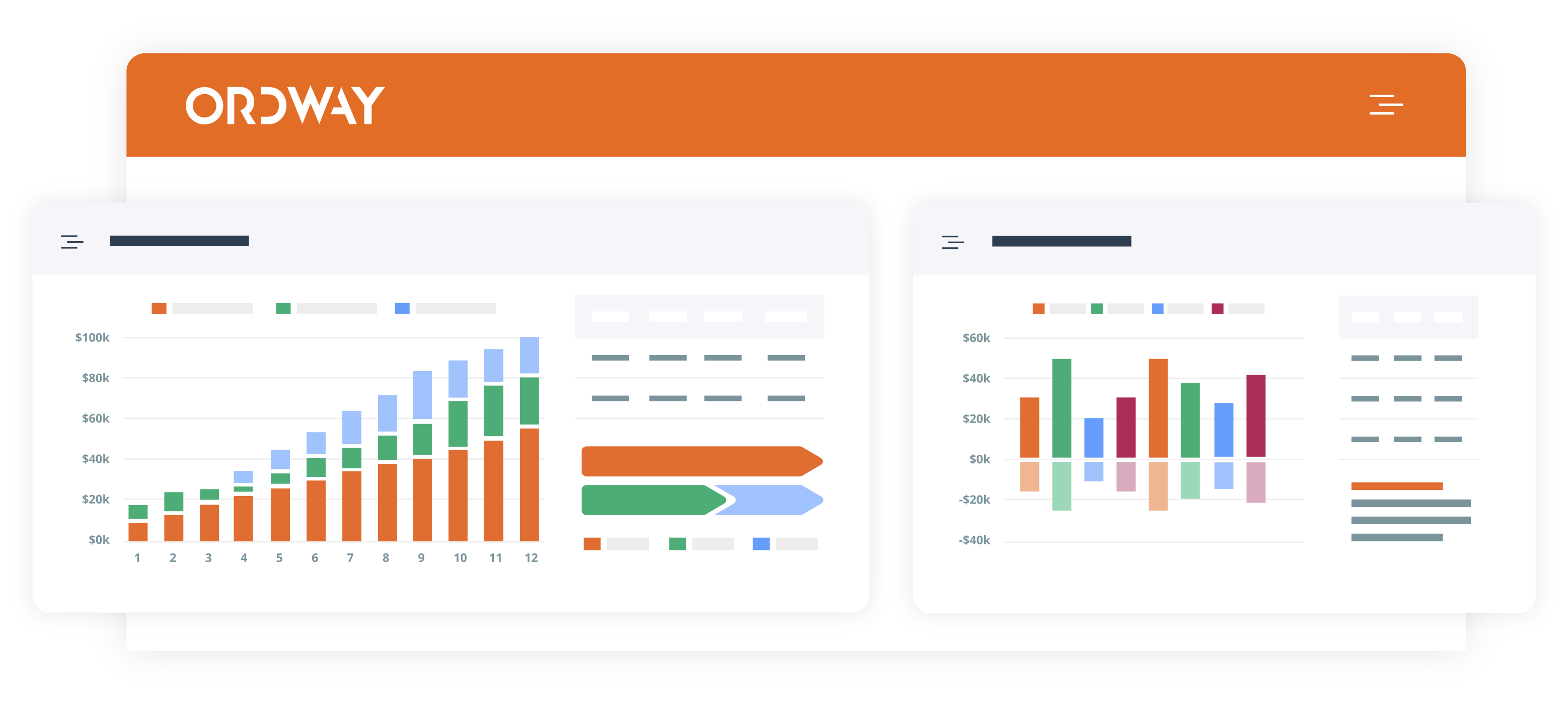
Ordway’s Revenue Recognition software automates end-to-end ASC 606 and IFRS 15 compliance, from capturing contract data through posting journal entries to the general ledger. The platform includes a dedicated revenue subledger with full audit trail, flexible recognition models including usage-based pricing, and native integrations with major CRM, billing, and GL/ERP systems.
For companies with multi-entity, multi-currency operations and complex pricing models, Ordway provides the compliance depth and operational flexibility that growing SaaS businesses require.
Frequently asked questions about revenue recognition software procurement
How long does revenue recognition software implementation typically take?
Implementation timelines vary based on contract volume and complexity. Most mid-market SaaS companies complete implementation within 8-16 weeks when accounting policies are documented in advance and stakeholders are aligned.
Can revenue recognition software replace my general ledger?
Revenue recognition software complements rather than replaces the GL/ERP. It serves as a specialized subledger that posts journal entries to the existing accounting system, maintaining the GL as the system of record for financial reporting.
Do private SaaS companies need revenue recognition software?
Private companies pursuing institutional funding or preparing for acquisition benefit from audit-ready revenue processes. Investors and acquirers expect clean financials, and retrofitting revenue recognition controls during due diligence creates unnecessary risk.
How does revenue recognition software handle usage-based billing?
Purpose-built solutions ingest consumption data and apply recognition rules based on delivered usage. This supports models like prepaid credits with drawdowns, overages, and consumption-based pricing where revenue is recognized as usage occurs.
Frequently Asked Questions
Revenue recognition software automates the process of tracking when and how revenue appears on financial statements, following accounting standards like ASC 606 and IFRS 15. For SaaS companies, it's critical because it directly impacts financial statements and investor reporting, making procurement decisions far more complex than typical SaaS purchases.
Accounting, IT, and operations teams must all have input on the decision. The process requires understanding how the platform handles ASC 606 compliance, contract modifications, and integration with your existing billing and ERP systems.
Map your contract data to the platform, test compliance with accounting standards, and verify how well the tool connects to your billing and ERP systems. The vendor must demonstrate how it implements the five-step ASC 606 model: identify the contract, identify performance obligations, determine transaction price, allocate price, and recognize revenue as obligations are satisfied.
Revenue recognition software directly impacts your financial statements and investor reporting, making it audit-sensitive. A casual approach of comparing demos and pricing can lead to expensive implementation mistakes, unlike lower-risk tools like expense management software.