Summary
For publicly traded SaaS firms, dissecting Annual Recurring Revenue (ARR) into distinct segments offers unparalleled clarity into their operational health and expansion pathways. Beyond a singular topline figure, this granular approach empowers stakeholders to grasp the true drivers of success. Explore how strategic ARR segmentation illuminates a company’s trajectory and informs critical business decisions.
TL;DR
- Segmenting Annual Recurring Revenue (ARR) provides a profound understanding of a SaaS company’s growth dynamics, surpassing the limitations of aggregate revenue figures.
- Leading SaaS enterprises commonly categorize ARR by product line, customer revenue tiers, industry verticals, deployment methods, and customer employee counts.
- While ARR is a non-GAAP financial measure, its detailed breakdown offers indispensable insights into a SaaS business’s current vitality and future potential.
- This detailed analysis empowers more precise strategic planning and investment choices by highlighting the specific contributions of various business aspects to overall ARR expansion.
1. Product Line Insights: Tracking Innovation and Market Maturity
Larger SaaS organizations often report ARR based on their primary product lines, typically two or three major offerings. This segmentation provides investors with a clear picture of how individual product growth contributes to the overall revenue narrative. For instance:
- A flagship product in a mature market might show steady, moderate ARR growth.
- A new offering, perhaps leveraging artificial intelligence, could exhibit rapid, high-percentage growth in an emerging segment.
- Revenue from a recent acquisition might be separately reported to validate the investment thesis and its integration success.
2. Customer Revenue Bands: Understanding Client Value Dynamics
Another prevalent method for ARR segmentation involves grouping customers by their annual revenues. Companies might use two (SMB vs. Enterprise) or three (Small Business, Mid-Market, Enterprise) distinct bands. This approach is particularly useful when a SaaS company’s market strategy focuses heavily on specific customer segments.
- It helps illustrate if strategic enterprise accounts are performing better than the broader customer base.
- Customer revenue data for private companies is often estimated through sales intelligence providers, as precise figures are rarely public.
- The revenue thresholds defining each segment can vary significantly between different SaaS providers.
3. Industry Vertical Analysis: Assessing Market Concentration and Risk
Segmenting ARR by industry vertical (e.g., financial services, healthcare, manufacturing), though less common, provides valuable insights into revenue diversification and market exposure. This data is generally straightforward to acquire from firmographic sources.
- It helps demonstrate that a company’s revenue isn’t overly concentrated in a single sector, mitigating investor risk.
- This segmentation can also reassure stakeholders that the business is not disproportionately exposed to industries facing economic downturns or specific challenges, as seen during periods like the pandemic.
4. Deployment Model Evolution: Navigating Cloud Transitions
Many legacy software giants are actively transitioning from traditional on-premise, perpetual license models to cloud-based, subscription services. For these companies, reporting ARR by deployment model is crucial.
- It highlights the growth momentum of their newer, cloud-centric subscription businesses, aligning with long-term strategic goals.
- Even ‘born-in-the-cloud’ companies sometimes offer self-managed versions, and segmenting by deployment helps investors understand customer preferences and growth in these areas.
- This transparency helps the investment community track the success of their shift towards more favorable SaaS business models.
5. Employee Count Segmentation: An Alternative View of Customer Size
As an alternative to customer revenue bands, some SaaS firms segment ARR based on the customer’s employee count. This data is often more readily available and accurate than precise revenue figures, frequently sourced from platforms like LinkedIn.
- Employee count segmentation can be used to isolate and analyze the performance of different-sized organizations.
- It’s particularly useful for excluding smaller accounts from certain metrics, as these often exhibit higher churn rates due to factors like bankruptcy or acquisitions.
- The specific employee count cutoffs for defining ‘small’ versus ‘enterprise’ vary between companies.
The Non-GAAP Nature of ARR: Calculation and Investor Value
Annual Recurring Revenue (ARR) is a key operational metric for SaaS companies, representing the annualized revenue from current active customer contracts over the next 12 months. It’s typically calculated as Monthly Recurring Revenue (MRR) multiplied by 12.
- ARR is a non-GAAP (Generally Accepted Accounting Principles) metric, meaning its calculation can differ slightly between companies.
- Despite this, investors widely utilize ARR alongside GAAP revenue to gain a holistic view of a SaaS business’s financial health and its capacity for future expansion.
- It assumes contract renewals without upgrades, downgrades, or cancellations, providing a baseline for recurring revenue expectations.
Conclusion
Mastering Annual Recurring Revenue through meticulous segment reporting is indispensable for comprehending the true vitality and growth trajectory of any SaaS venture. By breaking down ARR into granular categories like product, customer demographics, or deployment method, stakeholders gain invaluable clarity on performance drivers and potential vulnerabilities. This profound analytical depth empowers superior strategic decision-making, ensuring resources are optimally deployed to accelerate expansion and cultivate enduring value in a perpetually evolving market.
ARR Reporting Software
from Ordway
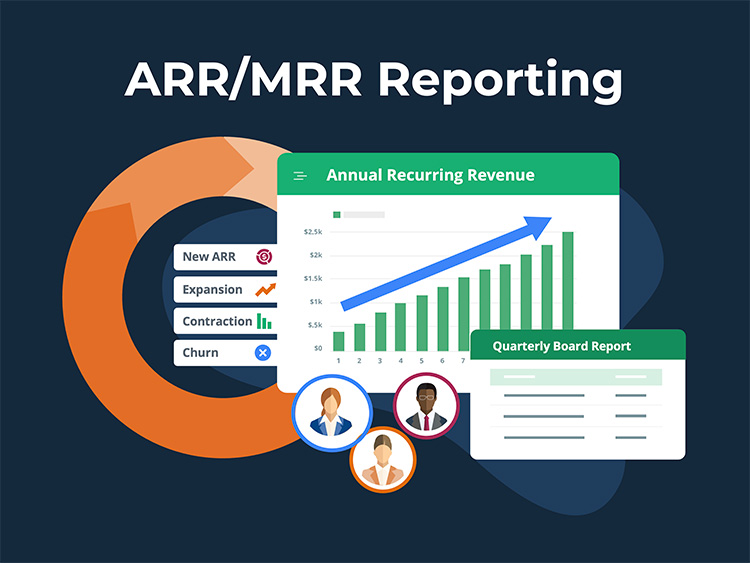
Track new, expansion, contraction, renewal, and churn ARR. Segment ARR by product line, geographic region, and legal entity. Report on ARR growth rates.