TL;DR: Payment Facilitator (Payfac)
A Payment Facilitator (or payfac) is a service provider that allows businesses to accept card and ACH payments without establishing their own individual merchant accounts. By aggregating multiple sub-merchants under a single master merchant account, they streamline onboarding and handle the complex compliance requirements that banks typically demand from individual merchants.
Key Takeaways
-
The Model: Payfacs (such as Stripe, Square, and PayPal) act as an intermediary, assuming the role of the “merchant of record” for their sub-merchants.
-
Operational Burden: They offload the heavy lifting from the business by managing underwriting, KYC (Know Your Customer) compliance, PCI standards, and chargeback disputes.
-
Economic Structure: Payfacs operate on a spread model, charging sub-merchants a flat-rate transaction fee that is higher than wholesale interchange rates, capturing the difference as revenue.
-
Target Audience: This model is ideal for SaaS platforms, marketplaces, and e-commerce companies that require near-instant onboarding and frictionless payment integration.
Implementation Steps
-
Evaluate Your Needs: Determine if your platform requires a turnkey solution (Payfac-as-a-service) or if the potential revenue margin justifies the significant time and capital investment required to become a registered Payfac.
-
Assess Integration: Ensure the chosen provider connects seamlessly with your existing subscription billing and revenue operations to automate the full order-to-revenue cycle.
-
Compare Economics: Look beyond simple transaction fees; evaluate the total cost of ownership, including platform fees, fraud management tools, and support overhead.
-
Prioritize Onboarding Speed: Select a partner based on how quickly they allow your end-users to go from signup to accepting their first payment, as this is the primary competitive advantage of the Payfac model.
The Bottom Line
The Payfac model is the industry standard for modern software platforms, replacing the weeks-long, paper-heavy underwriting process of the past with digital, near-instant merchant onboarding. Whether you are using a third-party Payfac to embed payments or deciding whether to build the infrastructure yourself, the goal remains the same: reducing friction for your customers while maintaining robust compliance and security.
Are you currently evaluating a Payfac integration to improve your merchant onboarding experience, or are you exploring whether to register as a full Payfac to capture more payment margin?
A Payment Facilitator—or payfac—is a service provider that lets businesses accept card and ACH payments without establishing their own merchant account with a bank. Instead of each merchant going through weeks of underwriting, the payfac holds a master merchant account and aggregates many sub-merchants underneath it, enabling near-instant onboarding. This model powers some of the most recognizable names in payments: Stripe, Square, PayPal, and Shopify Payments all operate as payfacs. Below, we’ll cover how payment facilitation works, how payfacs differ from processors and ISOs, who benefits most from the model, and what it takes to become one.
What is a Payfac?
What is a payment facilitator and why does it matter for businesses accepting payments?
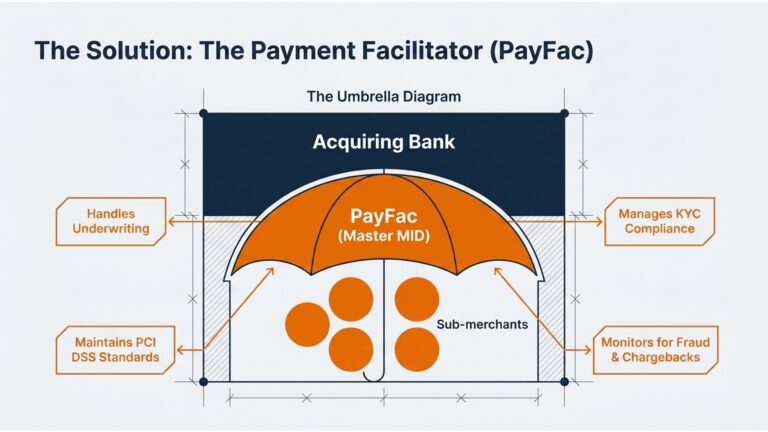
A Payment Facilitator (PayFac) is a service provider that streamlines merchant onboarding and payment processing by acting as an intermediary between sub-merchants and acquiring banks. Instead of each business applying for its own merchant account—a process that typically takes weeks—a payfac holds a single master merchant account and aggregates many smaller businesses underneath it. This structure allows software platforms to instantly onboard sub-merchants to accept credit cards and ACH payments.
- Sub-merchant: A business that processes payments under the payfac’s umbrella rather than through its own direct merchant account with a bank
- Acquiring bank: The sponsoring bank that enables card acceptance and settles funds to the payfac
- Master merchant account: The main merchant account the payfac controls on behalf of all its sub-merchants
- MID (Merchant ID): The identifier used to track merchant payment activity with card networks
Payfacs take on responsibilities that would otherwise fall to each individual merchant. First, they handle underwriting—assessing merchant risk before approval. Second, they manage KYC (Know Your Customer) compliance to prevent fraud and money laundering. Third, they maintain PCI compliance, meeting Payment Card Industry data security standards. Finally, they monitor transactions for suspicious activity and manage chargebacks.
How Payment Facilitation Works
How does the payfac model work from merchant signup to payment settlement?
The payfac model compresses what used to be a lengthy bank relationship into a streamlined workflow. When a business wants to accept payments through a payfac, the process typically unfolds in hours rather than weeks. The payment flow works like this: A sub-merchant applies through the payfac’s platform. The payfac then underwrites the merchant, often instantly using automated risk checks. Once approved, the sub-merchant is onboarded under the payfac’s master MID. When a customer makes a payment, the payfac processes the transaction through its acquiring bank, and funds settle to the sub-merchant’s bank account. In the traditional model, by contrast, each merchant applies directly to an acquiring bank, undergoes extensive underwriting, and receives its own MID. This process can take two to four weeks and requires significant documentation. The payfac model eliminates most of this friction by handling compliance and risk management centrally.

Examples of Payfacs
Which companies are well-known payment facilitators?
You’ve likely used products built on the payfac model without realizing it. Here are some of the most recognizable platforms operating as payfacs.
Stripe
Stripe operates as a payfac powering platforms and marketplaces worldwide. Its developer-friendly APIs and Stripe Connect product allow software companies to embed payments directly into their applications.
Square
Square serves small businesses with point-of-sale hardware and near-instant merchant onboarding. A coffee shop can start accepting card payments the same day it signs up.
PayPal
PayPal pioneered the payfac model in the early 2000s, enabling online payments for millions of merchants before most businesses had any way to accept credit cards on the internet.

PayPal
PayPal pioneered the payfac model in the early 2000s, enabling online payments for millions of merchants before most businesses had any way to accept credit cards on the internet.
Shopify Payments
Shopify Payments is an embedded payfac within Shopify’s e-commerce platform. Merchants can accept payments without integrating a third-party gateway—everything works natively within their store.
Is Amazon a payfac
Amazon is not a payfac. Amazon Pay functions as a digital wallet, allowing consumers to use their Amazon credentials to pay on other websites. Amazon Marketplace handles payments differently—as a marketplace operator managing transactions between buyers and sellers rather than aggregating merchants under a master MID.
How Payfacs Make Money
How do payment facilitators generate revenue from processing transactions?
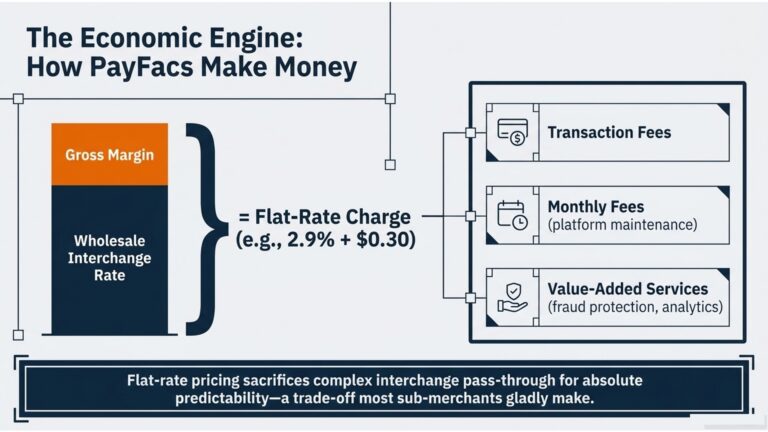
Payfacs operate on a spread model. They negotiate wholesale rates with their acquiring bank, then charge sub-merchants a markup on each transaction. The difference between what the payfac pays and what it charges is its gross margin.
- Transaction fees: A percentage of each transaction plus a fixed fee (e.g., 2.9% + $0.30)
- Monthly fees: Platform or account maintenance charges
- Value-added services: Fraud protection, chargeback management, analytics, and reporting tools
Flat-rate pricing is a hallmark of the payfac approach. Rather than passing through complex interchange rates that vary by card type, payfacs often charge a single percentage regardless of whether the customer pays with a debit card, rewards credit card, or corporate card. This simplicity comes at a cost—merchants typically pay more per transaction than they would with interchange-plus pricing—but the predictability often outweighs the difference for smaller businesses.
Advantages of using a Payfac
What are the benefits of using a payfac for payment processing?
Payfacs reduce friction for businesses that want to accept payments quickly without navigating complex banking relationships.
Faster merchant onboarding
Sub-merchants can often start accepting payments within hours or even minutes. Traditional merchant account underwriting, by contrast, can take two to four weeks and require extensive documentation.
Multiple payment methods and card networks
Payfacs typically support credit cards, debit cards, ACH bank transfers, and digital wallets through a single integration. There’s no need to establish separate relationships with multiple processors.
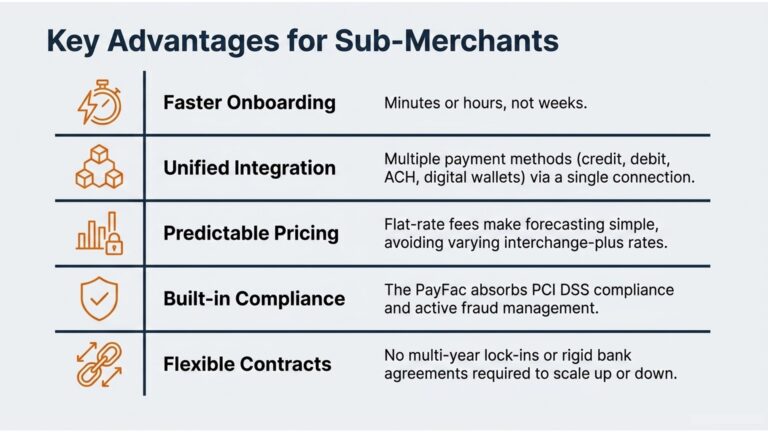
Predictable flat-rate pricing
A simple fee structure—say, 2.9% + $0.30 per transaction—makes costs easier to forecast than interchange-plus pricing, where rates vary by card type, transaction size, and merchant category.
Built-in fraud prevention and PCI compliance
The payfac handles security requirements on behalf of sub-merchants. Businesses benefit from fraud detection, chargeback management, and PCI DSS compliance without managing compliance themselves.
Flexible contracts for sub-merchants
Long-term commitments are typically not required. Sub-merchants can scale up, scale down, or switch providers without being locked into multi-year agreements.
Payfac vs Payment Processor, Gateway, ISO, and Aggregator
What is the difference between a payfac and other payment service providers?
The payments industry uses many overlapping terms. Here’s how payfacs compare to other entities you’ll encounter:
Payfac vs payment processor
A payment processor handles the technical routing of transaction data between merchants, card networks, and banks. The payfac, on the other hand, is the merchant of record that aggregates sub-merchants and owns the customer relationship.
| Entity | Role | Merchant Relationship |
|---|---|---|
| Payfac | Aggregates sub-merchants under master MID; handles underwriting and compliance | Sub-merchants onboard through payfac |
| Payment Processor | Routes transaction data between merchant and card networks | Works behind the scenes; merchant may not interact directly |
| Payment Gateway | Securely transmits payment data from checkout to processor | Technical integration layer |
| ISO | Sells merchant accounts on behalf of acquiring banks | Connects merchant to bank; merchant gets own MID |
| Payment Aggregator | Often used interchangeably with payfac | Similar to payfac model |
Payfac vs payment gateway
A payment gateway is the secure connection that transmits payment data from a checkout page to the processor. It’s a technical layer, not a business relationship. The payfac manages the merchant relationship and takes on compliance responsibilities.
Payfac vs ISO
An Independent Sales Organization (ISO) connects merchants to acquiring banks, where each merchant receives its own MID and direct bank relationship. With a payfac, merchants are aggregated under one master MID, and the payfac owns the full client experience.
Payfac vs payment aggregator
Payment aggregator and payfac are often used interchangeably. Both refer to entities that aggregate merchants under a master account rather than establishing individual merchant accounts for each business.

Who Payfacs are for
Which businesses benefit most from the payfac model?
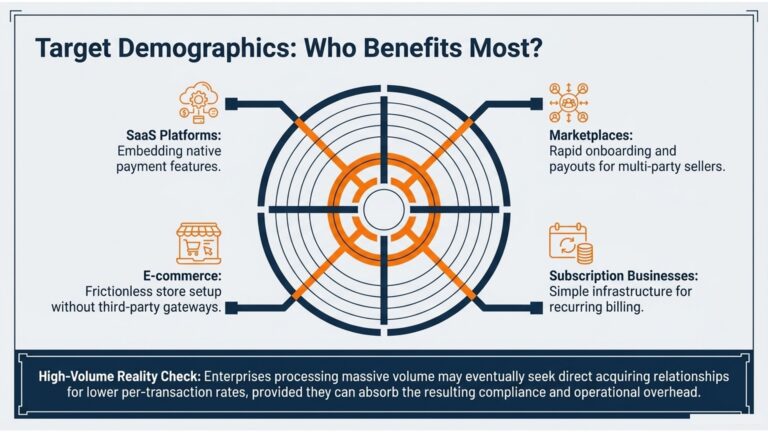
The payfac model works particularly well for businesses that prioritize speed and simplicity over the lowest possible transaction costs:
- SaaS platforms: Want to offer embedded payments as a native feature within their software
- Marketplaces: Need to onboard and pay out many sellers quickly
- E-commerce platforms: Enable merchants to accept payments without complex integrations
- Small and mid-sized businesses: Need fast setup without traditional bank underwriting
- Subscription businesses: Require recurring billing capabilities with simple payment infrastructure
High-volume enterprises may eventually benefit from direct acquiring relationships, which offer lower per-transaction rates. However, the operational overhead of managing compliance, underwriting, and risk often makes the payfac model more practical even for larger businesses.
Should you become a Payment Facilitator
Should your platform register as a payment facilitator or use an existing payfac solution?
For software platforms considering embedded payments, there’s a choice: use an existing payfac (like Stripe Connect) or register as a payfac yourself. Becoming a registered payfac means registering with card networks (Visa, Mastercard), obtaining sponsorship from an acquiring bank, and taking on full compliance responsibilities.
- Control: Full ownership of the merchant experience and pricing
- Revenue: Capture more of the payment margin
- Responsibility: Handle underwriting, risk, KYC, PCI compliance, and chargebacks
- Investment: Significant upfront and ongoing costs
A middle-ground option is payfac-as-a-service, where platforms get payfac-like benefits—embedded payments, merchant onboarding, revenue share—without completing full registration. The payfac-as-a-service provider handles compliance and card network relationships on the platform’s behalf.

Cost and Timeline to become a Payfac
What are the costs and time requirements to become a payment facilitator?
Full payfac registration is a significant undertaking, typically requiring 6 to 12 months.
Payment systems setup
Building or licensing payment infrastructure, integrating with processors, and completing card network certifications requires substantial investment, depending on complexity.
Sub-merchant onboarding and compliance
KYC/AML systems, underwriting workflows, card network registration fees, and PCI DSS certification add to the initial investment.
Ongoing operating costs
Risk monitoring, chargeback management, compliance maintenance, and customer support for sub-merchants create ongoing operational expenses. Many platforms find that payfac-as-a-service offers a faster path to market with lower upfront investment.

How to choose a Payfac
What criteria matter when selecting a payment facilitator for your business?
The right payfac depends on your business model, transaction volume, and payment needs.
Evaluate onboarding speed and sub-merchant underwriting
How quickly can you or your merchants start accepting payments? Some payfacs offer instant approval; others require manual review.
Confirm card network and payment method coverage
Ensure support for Visa, Mastercard, American Express, Discover, plus ACH and relevant digital wallets for your customer base.
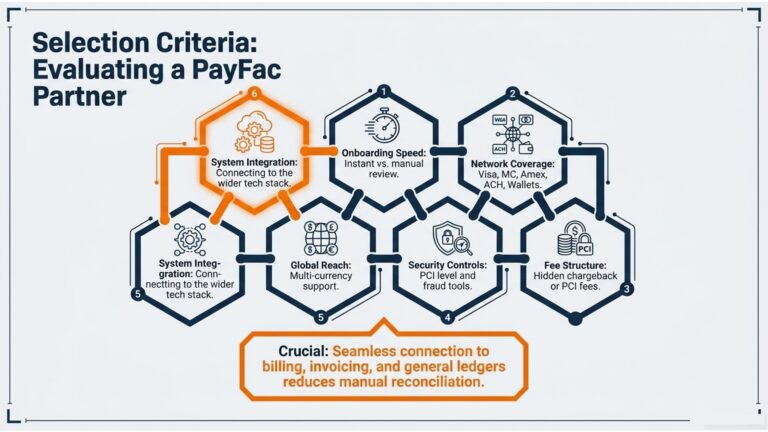
Compare fee structures and effective rates
Understand flat-rate versus interchange-plus pricing. Factor in transaction fees, monthly fees, and any hidden costs like chargeback fees or PCI compliance fees.
Verify security, PCI, and fraud controls
Confirm the payfac’s PCI DSS compliance level and review available fraud prevention tools.
Assess integration with billing and accounting systems
Seamless connection to subscription billing, invoicing, revenue recognition, and the general ledger reduces manual reconciliation. For subscription businesses, platforms like Ordway connect to payment gateways and payfacs to automate cash application and GL posting.
How Payfacs fit into Recurring Revenue Operations
How do payfacs integrate with subscription billing and revenue operations?
For SaaS and subscription businesses, payment collection is one piece of a larger order-to-revenue cycle. The payfac handles the transaction, but other systems manage what happens before and after.
- Subscription billing: Generating recurring invoices based on pricing models
- Payment collection: Payfac processes the actual transaction (cards, ACH)
- Cash application: Matching payments to invoices and updating accounts receivable
- Revenue recognition: Recognizing revenue per ASC 606/IFRS 15
- SaaS metrics: Tracking ARR/MRR, churn, and retention
Platforms using payfacs for collection still need billing infrastructure to handle pricing complexity, usage-based charges, prorations, and revenue compliance. Recurring billing platforms connect to payment gateways and payfacs to automate the full cycle from invoice generation through cash application and revenue recognition. For subscription businesses looking to automate billing and revenue operations alongside payment collection, explore Ordway’s recurring billing and payment solutions.

Frequently Asked Questions about Payfacs
What is a sub-merchant in the payfac model?
A sub-merchant is a business that processes payments through a payfac’s master merchant account rather than holding its own direct merchant account with an acquiring bank. The sub-merchant benefits from faster onboarding and reduced compliance burden.
Is a payfac the merchant of record?
Yes, a payfac is typically the merchant of record for transactions. The payfac’s name appears on customer card statements, and the payfac assumes liability for chargebacks and disputes before passing them through to sub-merchants.
How do payfacs handle chargebacks and disputes?
Payfacs manage the chargeback process on behalf of sub-merchants. They investigate disputes, submit representment documentation to card networks, and debit sub-merchant accounts when chargebacks are lost.
Can a SaaS company use a payfac for recurring subscription billing?
Yes, SaaS companies commonly use payfacs to collect recurring subscription payments. However, they typically need separate billing software to handle invoice generation, usage-based pricing, prorations, and revenue recognition.
What is payfac-as-a-service?
Payfac-as-a-service allows software platforms to offer embedded payment acceptance to their users without completing full payfac registration. The provider handles compliance, underwriting, and card network relationships on the platform’s behalf.