TL;DR: BACS (Bankers’ Automated Clearing Services)
BACS is the UK’s primary electronic system for secure, low-cost bank-to-bank transfers. It is the gold standard for high-volume, non-urgent payments where cost efficiency is prioritized over instant speed.
Key Takeaways
-
The Model: BACS operates on a three-working-day cycle. It facilitates two main types: Direct Debit (payee “pulls” funds) and Direct Credit (payer “pushes” funds, common for payroll).
-
Ideal Context: Best suited for recurring bills, subscriptions, employee salaries, and supplier payments within the UK.
-
Implementation Steps:
-
Choose a Method: Access the network as a direct submitter (requires a Service User Number) or through a BACS-approved bureau.
-
Collect Authorisation: For Direct Debits, ensure you have a signed mandate from the payer before attempting to collect funds.
-
Plan for Timelines: Submit payment files before the daily cut-off (typically 6:00 PM) to ensure funds settle by the third working day.
-
Billing Tech: Modern billing platforms can automate BACS collection, reducing administrative overhead and involuntary churn from expired cards.
-
The Bottom Line
BACS is the “workhorse” of the UK financial system. For businesses scaling in the UK, leveraging BACS is the key to minimizing transaction fees, ensuring predictable cash flow, and providing customers with a secure, “set-and-forget” payment experience.
Are you looking to integrate BACS into your recurring billing workflow, or are you comparing it against other UK payment rails like Faster Payments?
BACS (Bankers’ Automated Clearing Services) is the UK’s electronic payment system for bank-to-bank transfers, processing billions of transactions annually for payroll, supplier payments, and recurring billing. Payments take three working days to clear, making BACS the go-to method for high-volume, non-urgent transfers where cost efficiency matters more than speed. This guide covers how BACS works, the difference between Direct Debit and Direct Credit, processing timelines and costs, and how BACS compares to Faster Payments and CHAPS for UK businesses.
What is a BACS payment
What is a BACS payment and why do UK businesses use it?
BACS (Bankers’ Automated Clearing Services) is a secure, low-cost UK electronic system for direct bank-to-bank transfers. Payments typically take three working days to clear. The system powers two main payment types: Direct Debit for automated collections and Direct Credit for salaries and supplier payments. BACS handles billions of transactions annually, making it one of the most widely used payment methods in the United Kingdom. Businesses and individuals use BACS to move money between UK bank accounts without cash or cheques. The system works particularly well for high-volume, non-urgent payments where cost efficiency matters more than speed.
Common uses include:
- Payroll: Employers paying employee salaries on a regular schedule
- Supplier payments: Businesses paying vendors and contractors in bulk
- Recurring bills: Utility companies and subscription services collecting regular payments
- Pension distributions: Government and private pension payments to beneficiaries
What does BACS stand for
BACS stands for Bankers’ Automated Clearing Services. The system was established in 1968 to automate the clearing of payments between UK banks, replacing paper-based processes with electronic transfers. Today, BACS is operated by Pay.UK, the organisation responsible for the UK’s retail payment systems. While the acronym originally described the technical clearing function, “BACS” now refers broadly to the payment schemes and infrastructure that enable Direct Debit and Direct Credit transactions across the UK banking network.

Types of BACS payments
What are the two types of BACS payments?
BACS facilitates two distinct payment flows: Direct Debit and Bacs Direct Credit. The difference comes down to who initiates the payment and which direction the money moves.

BACS Direct Debit
Direct Debit is a “pull” payment where the payee (the business collecting money) withdraws funds from the payer’s bank account. Before any collection can occur, the payer authorises the arrangement by signing a Direct Debit mandate. Businesses collecting recurring payments from customers typically use Direct Debit. Think subscription fees, utility bills, gym memberships, and insurance premiums. Once the mandate is in place, payments happen automatically on schedule without requiring action from the payer.
Bacs Direct Credit
Bacs Direct Credit works in the opposite direction. It’s a “push” payment where the payer sends funds to the payee’s account. The paying organisation initiates the transfer, and no mandate from the recipient is required. Businesses typically use Direct Credit for payroll, pension payments, supplier invoices, and refunds. BACS processes salaries for approximately eight in ten UK employees through Direct Credit.
| Feature | Bacs Direct Debit | Bacs Direct Credit |
|---|---|---|
| Payment direction | Payee pulls funds | Payer pushes funds |
| Common uses | Subscriptions, bills, memberships | Salaries, pensions, supplier payments |
| Who initiates | Collecting business | Paying business |
| Requires mandate | Yes | No |
How to make a BACS payment
How do businesses submit a BACS payment?
Submitting BACS payments requires either becoming a direct submitter or working through a bureau or third-party provider. The complexity depends on your chosen submission method.
1)Register as a direct submitter or use a bureau To submit payments directly to BACS, you’ll need a Service User Number (SUN) from your bank. Direct submission requires approved software and involves setup fees, making it more suitable for organisations processing high volumes of payments. Alternatively, bureau services handle submissions on your behalf. Many modern billing and payment platforms integrate BACS submission, removing the need to manage the technical details yourself.
2)Collect bank details and authorisation For Direct Debit, you’ll need a signed mandate from the payer authorising you to collect funds from their account. For Direct Credit, you’ll collect the recipient’s sort code and account number. Incorrect bank details lead to failed payments, which create administrative overhead and delay cash collection.

3)Submit the payment file Upload your payment instructions via online banking or BACS-approved software. Files follow specific BACS formatting standards, and submissions have daily cut-off times, typically in the early evening.
4)Complete the three-day processing cycle Once submitted, payments follow the standard BACS cycle. Funds arrive in the recipient’s account on Day 3 after submission, assuming no issues arise during processing.
How long does a BACS payment take
How long does a BACS payment take to process?
BACS payments take three working days to clear. Working days exclude weekends and UK bank holidays. Unlike Faster Payments, BACS is not an instant transfer method.
The three-day BACS processing cycle The BACS cycle follows a predictable pattern:
- Day 1 (Input): The payment file is submitted to BACS by the sponsoring bank
- Day 2 (Processing): BACS processes and validates the payment instructions
- Day 3 (Settlement): Funds are debited from the payer and credited to the payee
For example, if you submit a payment file on Monday before the cut-off time, the funds will arrive in the recipient’s account on Thursday morning.
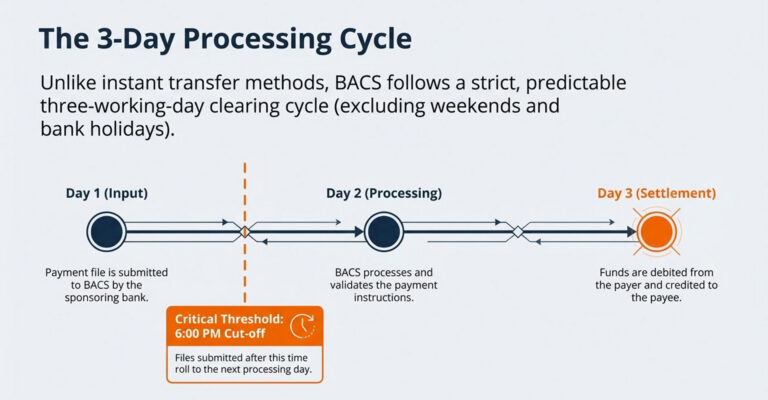
BACS cut-off times and payment windows Submissions typically have a cut-off time around 6:00 PM. Payments submitted after the cut-off roll to the next processing day, effectively adding an extra day to the timeline. Planning submissions in advance is particularly important for time-sensitive payments like payroll.
How much does a BACS payment cost
What does it cost to send or receive a BACS payment?
BACS is known for low per-transaction costs compared to other payment methods. For high-volume payments, it’s often the most economical option available. Costs vary by bank and submission method. Direct submitters typically pay lower per-transaction fees but face higher setup costs. Bureau users pay slightly more per transaction but avoid the upfront investment.
Typical fee types include:
- Setup fees: One-time cost to register for BACS access
- Per-transaction fees: Small charge per payment processed (often pence rather than pounds)
- Service fees: Monthly or annual charges from bureaux or software providers
Compared to card payments, which typically charge 1.5–3% of the transaction value, BACS fees are substantially lower, particularly for larger payment amounts.

Which banks use BACS in the UK
Which UK banks support BACS payments?
BACS is a centralised UK payment system, not a service offered by individual banks. All major UK banks and building societies participate in the BACS network. If your business has a UK bank account, you can likely use BACS. Participating banks include Barclays, HSBC, Lloyds, NatWest, Santander, and newer digital banks like Starling Bank and Monzo. Universal participation is what makes BACS effective for bulk payments. You can pay employees, suppliers, and customers regardless of which bank they use.

Is BACS the same as a bank transfer
Is a BACS payment the same as a bank transfer?
BACS is one type of bank transfer, but not all bank transfers use BACS. “Bank transfer” is a general term covering multiple payment rails in the UK. When you transfer money between UK bank accounts, the payment might travel via BACS, Faster Payments, or CHAPS depending on the amount, urgency, and how you initiate the transfer. BACS specifically refers to the three-day clearing system optimised for high-volume, non-urgent payments. When someone asks you to “pay by BACS,” they’re requesting you use this specific system rather than an instant transfer method.
BACS vs Faster Payments vs CHAPS
What is the difference between BACS, Faster Payments, and CHAPS?
The UK has three main interbank payment systems, each designed for different use cases. Choosing the right one depends on your priorities around speed, cost, and payment size.

Faster Payments
Faster Payments delivers near-instant transfers, typically completing within seconds. Most banks set limits on individual Faster Payments transactions, though limits have increased over time. The cost per transaction is higher than BACS but lower than CHAPS, making it best suited for urgent, lower-value payments.
CHAPS
CHAPS (Clearing House Automated Payment System) guarantees same-day settlement with no upper limit on payment value. It’s the most expensive option but provides certainty for large, time-critical transactions. Property purchases and high-value business transactions commonly use CHAPS.
When to use each UK payment method
| Factor | BACS | Faster Payments | CHAPS |
|---|---|---|---|
| Speed | 3 working days | Seconds to hours | Same day |
| Cost | Lowest | Medium | Highest |
| Best for | High-volume, regular payments | Urgent, smaller payments | Large, time-sensitive payments |
| Payment limit | No limit | Bank-dependent cap | No limit |
Is BACS safe and secure
Is BACS a safe and secure payment method?
Yes, BACS is considered a highly secure payment method. The system uses advanced encryption and secure transmission protocols, and it operates under UK financial services regulatory oversight.
The Direct Debit Guarantee
One of the strongest consumer protections in UK payments is the Direct Debit Guarantee. If a Direct Debit is collected in error or fraudulently, the payer can claim a full refund from their bank. Banks are required to refund immediately upon a valid claim, then investigate the matter with the collecting organisation. The guarantee builds trust for subscription and recurring billing models.

BACS security and compliance standards
Organisations submitting BACS payments go through an approval process and agree to follow BACS rules and procedures. The system maintains comprehensive audit trails, and all transactions flow through regulated infrastructure. For businesses with strict financial controls, BACS provides the documentation and traceability to support compliance and audit requirements.
BACS for Subscription Billing
Why do subscription businesses use BACS Direct Debit for recurring payments?
BACS Direct Debit has become a preferred payment method for subscription businesses operating in the UK. The combination of low transaction costs, automated collection, and reliable processing makes it well-suited for recurring revenue models.

- Lower fees: Transaction costs are significantly lower than credit card processing fees
- Automated collection: Payments are pulled automatically on schedule without customer action
- Reduced churn: Unlike cards, bank accounts don’t expire, reducing involuntary payment failures
- Customer convenience: Set-and-forget experience for subscribers
- Cash flow predictability: The three-day cycle means you know exactly when funds will arrive
Modern billing platforms can integrate BACS alongside other payment methods, allowing businesses to offer customers their preferred payment option while automating the collection process.
BACS vs ACH and SEPA for international expansion
BACS only operates within the UK. Subscription businesses expanding internationally need additional payment rails to collect from customers in other regions. ACH (Automated Clearing House) serves the United States, while SEPA (Single Euro Payments Area) covers the European Union and several other European countries. Businesses scaling globally benefit from billing platforms that support multiple bank transfer networks. Rather than building separate integrations for each region, a unified platform can handle BACS, ACH, SEPA, and other local payment methods through a single interface. Ordway’s recurring payments solution supports BACS, ACH, SEPA, and other global bank transfer methods, enabling subscription businesses to automate payment collection across multiple regions from one platform.
Choosing the Right UK Payment Method for Your Business
Selecting the appropriate payment method depends on your specific priorities around speed, cost, and payment volume. For high-volume recurring payments like payroll, subscriptions, and regular supplier payments, BACS Direct Debit or Direct Credit typically offers the best combination of low cost and reliability. The three-day processing time is acceptable when payments are predictable and planned in advance. For urgent one-off payments where timing matters, Faster Payments provides near-instant delivery at a moderate cost. CHAPS makes sense for large, time-critical transactions where same-day settlement is essential. Growing SaaS and subscription businesses often benefit from billing platforms that automate BACS collection alongside invoicing, dunning, and revenue recognition.

Frequently Asked Questions about BACS and UK Payments
Can BACS be used for international payments?
No, BACS is a UK-only payment system that transfers funds exclusively between UK bank accounts. For international payments, businesses use SWIFT for wire transfers, SEPA for European payments, or other cross-border payment networks depending on the destination country.
What happens if a BACS payment fails?
Failed BACS payments are returned with a reason code indicating the cause, such as insufficient funds or a closed account. The submitting organisation receives notification and can then resolve the issue or attempt collection through another method.
Can BACS payments arrive at any time of day?
BACS payments are credited to recipient accounts at the start of the business day on Day 3 of the processing cycle. The exact time funds appear may vary slightly by bank, but payments don’t arrive at random times throughout the day.
How do I cancel or reverse a BACS payment?
Direct Debits can be cancelled by the payer through their bank at any time. For Direct Credits already submitted, reversal depends on how far the payment has progressed through the three-day cycle. Contact your bank or bureau immediately if you need to stop a payment in progress.
What is the difference between BACS and SWIFT?
BACS is a domestic UK payment system for transferring funds between UK bank accounts. SWIFT is a global messaging network that facilitates international wire transfers between banks in different countries. BACS handles domestic bulk payments, while SWIFT handles cross-border transactions.