TL;DR: The Billing Cycle
A billing cycle is the recurring interval—typically 28 to 31 days—between consecutive statement closing dates. It is the window during which transactions, fees, and usage accumulate on an account before an invoice is generated and a new cycle begins.
Key Takeaways
-
The Model: Cycles can be based on Anniversary Billing (sign-up date) or Calendar Billing (fixed date for all). After a cycle closes, a statement is issued, followed by a grace period (21–25 days) before payment is due.
-
Ideal Context: Critical for SaaS, utilities, and credit card providers to manage cash flow, calculate credit utilization, and ensure accurate revenue recognition under standards like ASC 606.
-
Implementation Steps:
-
Define Frequency: Choose between monthly, quarterly, or annual cycles based on cash flow needs and customer commitment.
-
Configure Proration: Establish rules for mid-cycle changes (upgrades/downgrades) to ensure customers are charged proportionally.
-
Automate Metering: For usage-based models, integrate consumption data to automatically aggregate and rate usage at the end of the cycle.
-
Coordinate Due Dates: Align payment deadlines with the business’s own payables to optimize working capital.
-
-
Billing Tech: Modern subscription billing software automates invoice generation and proration, reducing manual errors and preventing involuntary churn.
The Bottom Line
Billing cycles are more than just calendar dates; they are strategic tools that dictate cash flow health and customer experience. For growing businesses, automating these cycles is essential to scaling operations without increasing administrative overhead or revenue leakage.
Are you looking to optimize your cash flow by shifting to a different billing frequency, or do you need help managing complex mid-cycle prorations?
A billing cycle is the recurring interval—typically 28 to 31 days—between consecutive statement closing dates when transactions, fees, and usage accumulate on your account before the next invoice is generated.
This guide covers how billing cycles work across credit cards, utilities, and subscription businesses, along with practical guidance for managing cycle timing, prorations, and payment windows.

What Is a Billing Cycle
What is a billing cycle and why does it matter?
A billing cycle is the recurring interval of time—typically 28 to 31 days—between consecutive statement closing dates. During this period, all transactions, fees, and usage accumulate on your account. Once the cycle closes, a statement is generated showing the total balance owed, and a new cycle begins immediately.

You’ll hear this concept called different things depending on the context. Statement period, billing period, and bill cycle all refer to the same idea. The terminology varies, but the mechanics stay consistent: it’s the window during which activity is tracked before an invoice appears.
- Billing cycle: The time between two consecutive billing statements
- Statement period: Another term for the same interval
- Billing period: The recurring timeframe that determines when invoices are generated
How Billing Cycles Work
How does a billing cycle work from start to finish?
A billing cycle follows a predictable sequence. Charges accumulate throughout the period, the cycle closes on a specific date, a statement is generated, and then a payment window opens. Understanding this flow helps you anticipate when invoices arrive and when payments are expected.
When a Billing Cycle Starts
A new billing cycle begins immediately after the previous one closes—there’s no gap between cycles. One ends, and the next starts on the following day.
Some providers use calendar-based billing, where cycles align with the first or last day of each month. Others use anniversary billing, where your cycle starts on the date you signed up. A customer who subscribes on March 15th, for example, would see their cycle run from the 15th of each month to the 14th of the next.
Statement Closing Date and Invoice Generation
The closing date marks the end of the billing period. All transactions recorded up to this point appear on the current statement, while any charges made after the closing date roll into the next cycle.
Once the cycle closes, the system generates an invoice or statement summarizing the period’s activity. This document shows itemized charges, credits, and the total amount due.
Grace Periods and Payment Windows
After the statement is generated, you typically have a grace period before payment is due. This window—often 21 to 25 days for credit cards—allows time to review charges and submit payment without incurring late fees or interest.
The payment due date is distinct from the billing cycle end date. Confusing these two dates is a common source of missed payments.
How Long Is a Billing Cycle
How long is a billing cycle typically?
Most billing cycles last between 28 and 31 days, though the exact duration varies by provider and industry. Credit cards, utilities, and subscription services each approach cycle length differently based on their operational needs.
28 to 31 Day Billing Cycles
The most common billing cycle length falls within this range. Credit card issuers and monthly subscription services typically use cycles that approximate one calendar month.
Because months vary in length, your cycle might be 28 days in February and 31 days in March. This slight variation is normal and doesn’t affect how charges are calculated.

Weekly and Biweekly Billing Cycles
Some industries use shorter billing periods. Payroll services often run on weekly or biweekly cycles, and certain utilities and high-frequency consumption services also bill more frequently to improve cash flow predictability.
Monthly, Quarterly, and Annual Billing Cycles
Longer billing cycles are common in B2B contexts and enterprise software agreements. Annual billing often comes with discounts, while monthly billing offers flexibility. The right choice depends on cash flow preferences and commitment level.
Billing Cycle vs Payment Due Date
What is the difference between a billing cycle and a payment due date?
The billing cycle is the period when transactions are recorded. The payment due date is the deadline for submitting payment after the statement is generated. These two concepts are related but distinct.

- Billing period: When transactions accumulate on your account
- Payment due date: The deadline for payment submission
- Grace period: The time between cycle end and due date
For example, a billing cycle might run from January 1st to January 31st. The statement is generated on February 1st, and payment might be due on February 21st. The 20-day window between statement generation and due date is the grace period.
How Credit Card Billing Cycles Work
What is a credit card billing cycle and how does it affect cardholders?
Credit card billing cycles follow the same general principles as other billing cycles, but they have specific implications for interest charges and credit scores.
Credit Card Statement Cycle and Closing Date
Your credit card statement cycle typically runs 28 to 31 days. You can find your closing date printed on your monthly statement, usually labeled “Statement Closing Date” or “Billing Period.”
All purchases, payments, and fees posted before the closing date appear on that month’s statement. The closing date also determines when your balance is reported to credit bureaus.
How Billing Cycles Affect Credit Scores
Credit utilization—the percentage of available credit you’re using—is calculated based on your balance at the end of each billing cycle. This figure is then reported to credit bureaus.
If you carry a high balance when your cycle closes, your credit utilization will appear elevated, even if you pay in full before the due date. Timing large purchases or making mid-cycle payments can help manage reported utilization.
Subscription and SaaS Billing Cycles
How do billing cycles work for subscription and SaaS businesses?
For subscription businesses, billing cycles determine when recurring invoices are generated and when revenue can be recognized. The complexity increases when contracts include usage-based components, mid-term changes, or multi-year commitments.
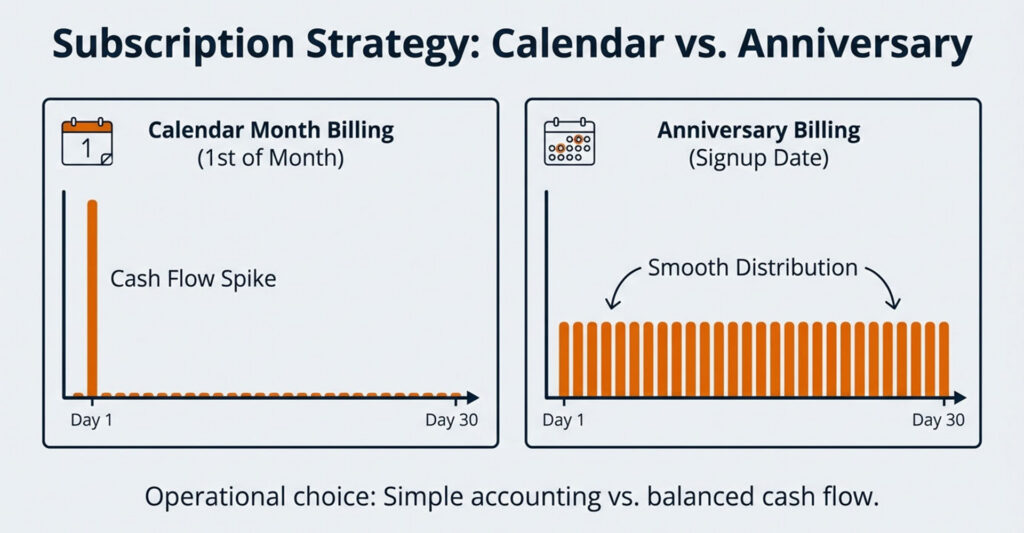
Calendar Month Billing vs Anniversary Billing
Subscription providers typically choose between two approaches:
- Calendar month billing: All customers are invoiced on the same date each month, simplifying accounting and forecasting
- Anniversary billing: Each customer is invoiced on their signup anniversary, spreading billing workload throughout the month
Calendar billing makes financial close easier but can create cash flow spikes. Anniversary billing distributes revenue more evenly but requires more sophisticated billing automation.
Mid-Cycle Changes, Upgrades, and Prorations
When customers upgrade, downgrade, or modify their subscription mid-cycle, the billing system calculates prorations. Proration adjusts charges proportionally based on the number of days remaining in the current cycle.
For example, if a customer upgrades from a $100/month plan to a $200/month plan halfway through the cycle, they’d be credited for the unused portion of the original plan and charged for the remaining days at the new rate. Billing platforms like Ordway handle proration calculations automatically.

Usage-Based and Consumption Billing Cycles
Usage-based pricing adds another layer of complexity. Consumption data—API calls, storage, transactions—accumulates throughout the cycle and is rated against the pricing model before the invoice is generated.
The billing cycle end triggers usage aggregation, rating calculations, and invoice generation. This process requires tight integration between metering systems and billing platforms.
Why Billing Cycles Matter for Business Finances
Why do billing cycles matter for business operations?
Billing cycle decisions affect cash flow timing, revenue recognition, and customer satisfaction. What seems like a simple operational choice has strategic implications.
Cash Flow Management and Working Capital
Shorter billing cycles accelerate cash collection. Monthly billing brings cash in faster than quarterly billing, improving working capital and reducing days sales outstanding (DSO).
However, more frequent billing also means more invoices to process and more opportunities for payment failures. The right balance depends on your operational capacity and customer preferences.

Revenue Recognition and ASC 606 Alignment
Billing cycles and revenue recognition schedules are related but separate. You might bill annually upfront while recognizing revenue monthly over the contract term.
Under ASC 606 and IFRS 15, revenue is recognized when performance obligations are satisfied, not necessarily when invoices are generated. Billing automation platforms help maintain this separation while keeping both processes synchronized.

Customer Experience and Payment Flexibility
Offering flexible billing cycle options can reduce involuntary churn. Some customers prefer billing aligned with their own fiscal calendar or payroll cycles, and allowing customers to choose their billing date improves payment compliance and reduces support inquiries about timing.
Billing Cycle Examples Across Industries
How do billing cycles differ across industries?
Billing cycle practices vary significantly based on industry norms, regulatory requirements, and customer expectations.
Credit Cards and Financial Services
Credit card issuers use monthly cycles with grace periods for interest-free payment. The cycle length is typically fixed, though customers can sometimes request a different closing date.

Utilities and Telecommunications
Utility billing cycles often align with meter reading schedules rather than calendar months. Your electric bill might cover a 32-day period one month and a 29-day period the next, depending on when the meter is read.
SaaS and Cloud Software
SaaS companies typically offer monthly or annual billing cycles, often with discounts for annual prepayment. Usage-based components are metered continuously and rated at cycle end.
Streaming and Subscription Services
Consumer subscription services usually bill on the anniversary of signup. Your streaming service charges on the same date each month, regardless of how many days are in that month.
How to Find and Change Your Billing Cycle Dates
How do you find your current billing cycle dates?
Locating your billing cycle information is straightforward once you know where to look.
Finding Your Current Billing Cycle
Check your most recent statement for labels like “Statement Period,” “Billing Cycle,” or “Closing Date.” Online account portals typically display this information in account settings or billing history sections.
For business accounts, your contract or service agreement specifies billing terms including cycle dates and payment windows.
Requesting a Billing Cycle Change
Many providers allow billing cycle adjustments upon request. Credit card issuers often accommodate date changes to align with paydays, and subscription services may offer similar flexibility.
For B2B relationships, billing cycle terms are typically negotiated during contract discussions. Billing platforms give providers the flexibility to configure different cycle dates for different customers.
Best Practices for Managing Billing Cycles
What are best practices for managing billing cycles effectively?
Finance teams can optimize billing cycle management through automation and strategic alignment.
Align Billing Cycles with Cash Flow Timing
Coordinating billing dates with your own payables and operational expenses helps maintain healthy working capital. If major vendor payments are due on the 15th, billing customers on the 1st gives you time to collect before those obligations come due.
Automate Invoice Generation and Payment Reminders
Manual invoice creation introduces delays and errors. Automated billing systems generate invoices immediately when cycles close and send payment reminders on schedule.

Offer Flexible Billing Cycle Options to Customers
Allowing customers to select billing dates that align with their own cash flow reduces payment friction. This flexibility is especially valuable for enterprise customers with specific procurement cycles.
Track Billing Cycle Performance and DSO Metrics
Monitoring days sales outstanding and payment timing by billing cycle date can reveal patterns. You might discover that customers billed on certain dates pay faster, informing future cycle assignments.
Common Billing Cycle Mistakes to Avoid
What billing cycle mistakes do businesses commonly make?
Several pitfalls can undermine billing cycle effectiveness:
- Misaligning billing and revenue recognition: Creates compliance issues and audit risk under ASC 606
- Inconsistent cycle lengths: Confuses customers and complicates forecasting
- Manual billing processes: Increases errors and delays invoice delivery
- Ignoring failed payments: Leads to revenue leakage and increased churn
- Inflexible billing dates: Frustrates customers and increases payment failures

Automate Your Billing Cycles for Faster Growth
Modern billing platforms automate the entire billing cycle—from invoice generation through payment collection and revenue recognition. This automation eliminates manual work, reduces errors, and scales with your business.
Ordway’s subscription billing software handles complex billing cycles including prorations, usage rating, and multi-currency support. Whether you bill monthly, quarterly, or annually—or combine subscription and consumption pricing—the platform manages cycle timing, invoice generation, and payment collection automatically.

Frequently Asked Questions
A billing cycle is the recurring interval, typically 28 to 31 days, between consecutive statement closing dates when transactions, fees, and usage accumulate before an invoice is generated.
After a cycle closes and a statement is issued, you typically have a grace period of 21 to 25 days before payment is due.
Anniversary Billing is based on your sign-up date, while Calendar Billing uses a fixed date for all customers. Both reset after each cycle closes and a new invoice is generated.
Choose between monthly, quarterly, or annual cycles based on your cash flow needs and customer commitment. Monthly is most common for SaaS.
Proration rules charge customers proportionally for the remainder of the cycle, so they only pay for the time they used each service level.