TL;DR: Billing Address
A billing address is the specific address linked to a user’s credit card, debit card, or bank account. It serves as a vital security layer that financial institutions and merchants use to verify a cardholder’s identity and prevent fraudulent transactions through the Address Verification Service (AVS).
Key Takeaways
-
The Purpose: It acts as a verification tool to ensure the person making a purchase is the authorized cardholder. It is also used to determine tax jurisdictions for digital goods.
-
Billing vs. Shipping: While a shipping address designates where physical goods are delivered, the billing address must match the bank’s records to authorize the payment. They do not need to be the same.
-
AVS Verification: Systems specifically check the numeric portions of the address (like street number and ZIP code). A mismatch often leads to declined transactions.
-
Maintenance: Keeping this address updated is critical for subscription-based businesses to avoid “involuntary churn,” where services are interrupted due to failed recurring payments.
Implementation Steps
-
Verify at Onboarding: Use billing automation to validate customer addresses during signup to prevent future payment failures.
-
Enable Self-Service: Provide customer portals where users can independently update their billing information when they move or change banks.
-
Standardize Data: Ensure your recurring billing software standardizes address formats (e.g., “Street” vs “St.”) to improve AVS match rates and reduce manual intervention.
-
Monitor Failed Payments: Implement dunning workflows to alert customers immediately if a transaction fails due to an outdated billing address.
The Bottom Line
A billing address is more than just a mailing location; it is a fundamental component of payment security and revenue retention. For businesses managing complex cycles, ensuring billing address accuracy is the key to reducing declined transactions, maintaining SaaS compliance, and providing a seamless customer experience.
Are you looking to automate the verification of customer billing data within your payment workflows, or are you currently handling address updates and failed payments manually?
What Is a Billing Address and How Is It Used?
A billing address is the address linked to your credit card, debit card, or bank account that banks and merchants use to verify your identity when you make a payment. It’s the address where your card issuer sends statements, and it’s what gets checked against the Address Verification Service (AVS) to help prevent fraud.
Getting your billing address wrong—or forgetting to update it after a move—can lead to declined transactions, failed subscription payments, and misdirected invoices. This guide covers how billing addresses work, where to find yours, how to update it, and what subscription businesses need to know about managing billing addresses at scale.

What Is a Billing Address?
What exactly is a billing address, and why does it matter for payments?
A billing address is the specific address linked to your credit card, debit card, or bank account. Banks and merchants use it primarily for security verification through the Address Verification Service (AVS) to prevent fraud. Your billing address is also where your card issuer sends statements and important correspondence.
While your billing address is often your home address, it can also be a business address. What matters is that it matches the address on file with your financial institution. When you make a purchase online or over the phone, the merchant asks for your billing address to verify you’re the authorized cardholder. If the address you enter doesn’t match what your bank has on file, the transaction may be declined.
Your billing address is tied to:
- Credit cards: The address registered with your credit card issuer
- Debit cards: The address associated with your bank account
- Bank accounts: The official address your bank has on record
- Utility and subscription accounts: The address linked to recurring service payments
What Is Your Billing Address Used For
Why do merchants and banks require a billing address?
The billing address serves several functions beyond simply identifying where you live. It’s a key component of payment security and helps businesses maintain accurate records for invoicing and tax purposes.
Verifying cardholder identity
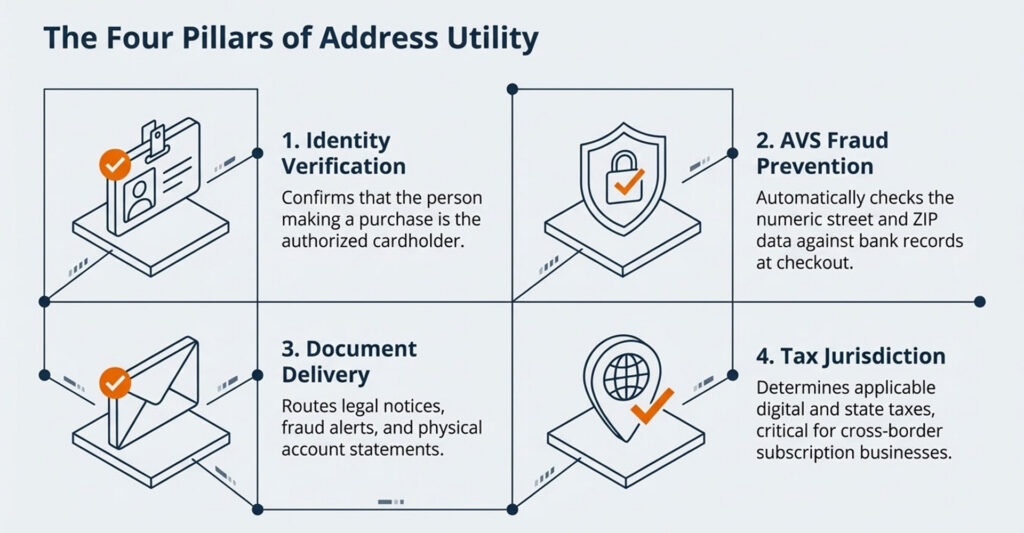
Merchants use the billing address to confirm that the person making a purchase is the authorized cardholder. When you enter your billing address at checkout, the merchant’s payment system checks it against the address your bank has on file. This verification step helps prevent unauthorized use of your payment method.
Enabling Address Verification Service
The Address Verification Service (AVS) is a fraud prevention tool that compares the billing address entered at checkout against the address on file with the card issuer. AVS specifically checks the numeric portions of your address, including the street number and ZIP code, to determine if there’s a match.
A mismatch between the two addresses can trigger a declined transaction. However, merchants can configure how strictly they enforce AVS results. Some may decline any mismatch, while others may flag the transaction for manual review.
Determining Tax Jurisdiction
For digital goods and services, the billing address may be used to determine which tax rates apply based on the customer’s location. This is particularly relevant for subscription businesses that operate across multiple states or countries, where tax obligations vary by jurisdiction.
Billing Address vs Shipping Address
What’s the difference between a billing address and a shipping address?
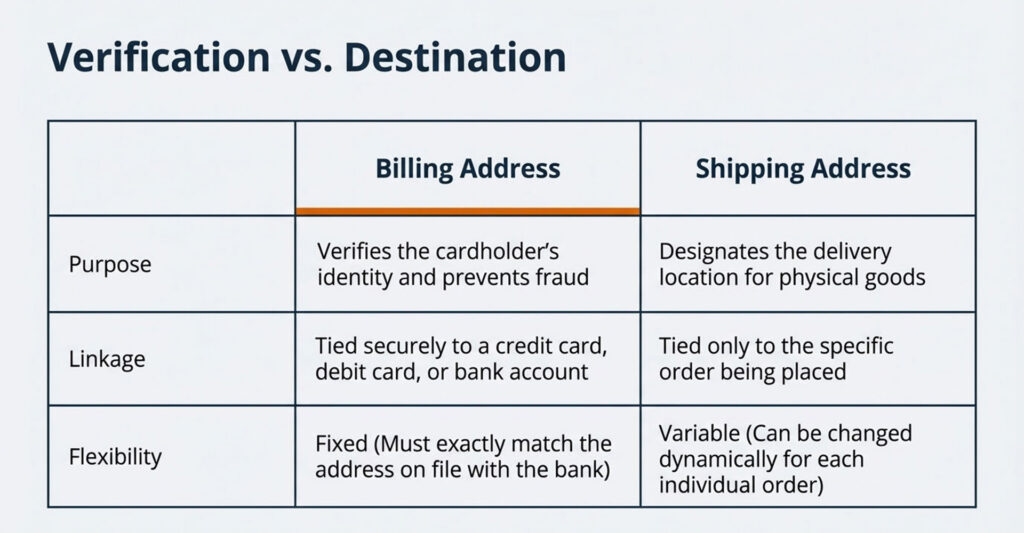
The billing address is tied to the payment method for verification, while the shipping address is the location where physical goods are delivered. The two addresses can be the same, or they can be different.
| Billing Address | Shipping Address | |
|---|---|---|
| Purpose | Verifies the cardholder's identity and prevents fraud | Designates the delivery location for physical goods |
| What it's linked to | A credit card, debit card, or bank account | The specific order being placed |
| Can it be changed per order? | No, it has to match the address on file with the bank | Yes, it can be changed for each individual order |
For example, if you’re ordering a birthday gift for a friend, you’d use your home address as the billing address (because that’s what your credit card company has on file) and your friend’s address as the shipping address. The billing address verifies your payment, while the shipping address tells the merchant where to send the package.
How to Find Your Billing Address
Where do I find my billing address?
You can find your billing address in several common places. The key is to locate the official address your bank or card issuer has on record, since that’s what merchants will verify against.
Check your credit card or bank statement
Your paper or electronic statements from your bank or credit card issuer display the official billing address on file. Look at the top of your statement where your name and address appear. This is the address your bank uses for AVS verification.
Log in to your card issuer or bank account
Online banking portals and mobile apps show the registered billing address under your account settings or profile section. Most banks label this as “mailing address” or “billing address” in your account preferences. This is often the quickest way to confirm your current billing address.
Review utility or subscription bills
Recurring bills from utilities or subscription services also reflect the billing address associated with that specific account. Keep in mind that the address on a utility bill may not always match your credit card billing address if you’ve updated one but not the other.
How to Change Your Billing Address
How do I update my billing address after moving?
Updating your billing address after moving is important because AVS checks will fail if you enter your new address while your bank still has your old address on file. Here’s the typical sequence for updating your billing address across all relevant accounts.
Update your address with your bank or card issuer
Contact your bank or card issuer directly, or update your address through their online banking portal or mobile app. This is the primary source of truth for AVS checks, so it’s the most critical update to make. Most banks allow you to change your address instantly online, though some may require additional verification for security purposes.
Notify subscription services and recurring billers
SaaS platforms, streaming services, and other recurring billers may store your billing address separately. Even though your bank has your new address, subscription services often cache the billing address from when you first signed up. Check each subscription’s account settings to update your billing information.
Update stored payment methods on e-commerce and SaaS platforms
Saved payment methods on e-commerce sites and software platforms often retain the old billing address. If you have payment methods saved on Amazon, your company’s software subscriptions, or other platforms, you’ll want to update each one separately.
Tip: Create a list of all your recurring subscriptions and saved payment methods before you move. This makes it easier to systematically update each one and avoid unexpected payment failures.
What Happens If Your Billing Address Is Wrong
What problems occur when a billing address doesn’t match?
Mismatched or outdated billing addresses can lead to several consequences, ranging from minor inconveniences to more serious issues with your accounts.
Declined transactions and failed payments
AVS mismatches cause transactions to be declined at checkout, leading to failed purchases or subscription payment failures. For one-time purchases, this is frustrating but easily resolved. For recurring subscriptions, however, a failed payment can interrupt your service or trigger late fees.

Misdirected invoices and statements
Important billing documents may be sent to the wrong address, which can cause you to miss payments and incur late fees. This is especially problematic for accounts that still rely on paper statements or for important notices that aren’t duplicated electronically.
Increased fraud risk and account flags
Repeated AVS failures can flag an account for potential fraud, which may lead to temporary holds or additional verification requirements from your bank. If your bank sees multiple failed verification attempts, they may freeze your card as a precaution until you confirm your identity.
Billing Address Considerations for Subscription and B2B Invoicing
How do billing addresses work for subscription billing and B2B invoices?
In recurring revenue and business contexts, the function of a billing address has specific implications that go beyond individual consumer transactions. For companies managing subscription relationships, billing address accuracy directly affects revenue collection and customer experience.

Why accurate billing addresses matter for recurring revenue
For subscription businesses, an outdated billing address is a common cause of recurring payment failures. Unlike one-time purchases where a customer can simply re-enter their information, failed subscription payments can silently interrupt service and damage customer relationships. This type of payment failure, often called involuntary churn, represents revenue lost not because the customer wanted to cancel, but because the payment couldn’t be processed.
Validating addresses to reduce payment failures
Billing platforms can validate addresses at checkout or during customer onboarding to prevent future payment issues. Address validation catches typos, formatting inconsistencies, and incomplete addresses before they cause problems. Some platforms also standardize address formats to improve AVS match rates.

Managing billing address updates across contracts
B2B companies with multi-year contracts often have processes to capture and update billing addresses when customers relocate or change payment methods. This is particularly important for enterprise accounts where the billing contact may change due to organizational restructuring.
Billing automation platforms can help streamline this process by providing customer self-service portals where buyers can update their own billing information without requiring manual intervention from the vendor’s finance team.
Simplify Billing and Payment Collection for Recurring Revenue
Managing billing addresses is one component of broader billing automation. For subscription and SaaS businesses, maintaining accurate customer billing information is essential for reducing payment failures and involuntary churn.
Platforms like Ordway automate recurring billing, payment collection, and dunning workflows while providing customer self-service portals where customers can update their own billing information.
Frequently Asked Questions
Can I use a P.O. Box as my billing address?
Some card issuers accept P.O. Boxes, while others require a physical street address. The policy varies by institution, so check with your bank or card issuer to confirm what they allow. If your bank accepts a P.O. Box, that’s the address you’d use for billing verification.
Does my billing address have to match my shipping address?
No, your billing address and shipping address can be different. This is common when sending a gift to someone else’s home, having items delivered to your workplace, or using a P.O. Box for mail while having packages delivered to a physical address.
What billing address do I use for a business credit card?
Use the address registered with your company’s bank or card issuer, which is typically the business’s official address on file. This might be your company’s headquarters, a registered agent address, or the address of the cardholder depending on how the account was set up.
Why was my payment declined even though my billing address is correct?
Declines can occur if there’s a minor formatting difference (e.g., “Street” vs “St.” or “Apartment” vs “Apt.”) or if your bank’s records haven’t been fully updated after a recent change. Contact your card issuer to verify the exact address they have on file, including how it’s formatted.
How often do I verify my billing address is up to date?
Reviewing your billing address whenever you move, change banks, or receive a new card is a good practice. It’s also worth confirming periodically if you have recurring subscriptions or auto-pay enabled, since a mismatch can cause unexpected payment failures.