Product-led growth (PLG) is a go-to-market strategy where the product itself drives customer acquisition, conversion, and retention—rather than traditional sales and marketing teams. Companies like Slack, Zoom, and Dropbox built billion-dollar businesses by letting users experience value before ever talking to sales.
This guide covers how PLG works, why it’s replacing sales-led models, and the metrics, pricing strategies, and operational infrastructure required to implement it successfully.

What is Product Led Growth
What is product-led growth and why has it become the dominant go-to-market strategy for SaaS companies?
Product-led growth (PLG) is a go-to-market strategy where the product itself drives customer acquisition, retention, and expansion, minimizing reliance on traditional sales and marketing teams. By offering free trials or freemium models, companies allow users to experience immediate value, accelerating adoption and reducing costs.
The core idea is straightforward: let the product do the selling. Instead of pushing prospects through demos and sales calls, PLG companies design their software so users can sign up, onboard themselves, and reach an “aha moment” without any human intervention.

Key characteristics of product-led growth include:
- User-centric experience: The product is designed for self-service onboarding and quick time-to-value
- Freemium or free trials: Users test features and experience value before purchasing
- Low-touch sales: The product drives adoption, reducing reliance on large sales teams
- Virality: Built-in features encourage users to invite others, driving organic growth
- Data-driven optimization: In-product analytics continuously improve the user experience
What Does PLG Stand For and What Does It Mean
What does PLG stand for and how is it used in SaaS contexts?
PLG stands for Product-Led Growth. Blake Bartlett at OpenView Venture Partners coined the term in 2016 to describe companies using their product as the primary growth engine.
In practice, PLG means the product serves as both the marketing and sales vehicle. Users discover value through direct experience rather than through pitch decks or demos. You’ll often hear related terms like “product-led organization” (a company structured around PLG), “product-led marketing” (marketing that drives users into the product), and “PLG company” (a business using this model as its primary go-to-market strategy).

Why Product Led Growth is Replacing Sales Led Strategies
Why are SaaS companies shifting from sales-led to product-led growth models?
Several market forces are driving this shift. Traditional sales-led approaches face mounting challenges that PLG directly addresses.
Rising Customer Acquisition Costs in SaaS
High-touch sales teams, outbound campaigns, and lengthy sales cycles have made customer acquisition increasingly expensive—CAC has risen 222% over eight years. PLG offers a more efficient alternative where users essentially acquire themselves through direct product experience.
Buyer Preference for Self Service Evaluation
Modern B2B buyers prefer researching and trying products independently before engaging sales. According to Gartner, 61% prefer an overall rep-free buying experience, wanting to experience value firsthand rather than sitting through demos and negotiations.

Demand for Frictionless Product Experiences
Users now expect consumer-grade experiences in B2B software. They want to sign up, onboard, and see value immediately without mandatory sales calls or implementation projects.
Limitations of the Traditional Sales Led Model
Sales-led models often create leaky acquisition funnels, organizational silos between product and sales teams, and slower product development when sales priorities dominate the roadmap.
Benefits of a Product Led Growth Strategy
What are the key benefits of adopting a product-led growth strategy?
PLG delivers advantages across acquisition, retention, and unit economics. Here’s what changes when the product becomes the primary growth driver.
Lower Customer Acquisition Costs
Product-driven acquisition is more efficient than high-touch sales. Users self-qualify by using the product, which typically results in lower customer acquisition cost (CAC). CAC measures the total sales and marketing spend required to acquire a new customer.
Faster Time to Value for Customers
Self-service onboarding allows users to experience core value almost immediately. There’s no waiting through lengthy sales and implementation cycles common in enterprise software.

Scalable and Efficient Revenue Growth
PLG models can scale revenue without proportionally increasing headcount. The product handles acquisition and activation at high volume, while sales teams focus on larger opportunities.
Higher Net Dollar Retention Rates
Net Dollar Retention (NRR) measures revenue retained from existing customers, including expansion and accounting for churn. Users who join through self-service tend to expand usage organically, and product data helps identify expansion opportunities early.
Stronger Product Market Fit Signals
Direct usage data provides immediate feedback on which features users value most. This enables faster iteration and ensures the roadmap aligns with actual market behavior rather than sales team anecdotes.
Product Led Growth Examples
Which companies have successfully implemented product-led growth?
The following examples demonstrate different PLG mechanics—network effects, referrals, and viral loops—that have driven significant growth.
Slack
Slack’s growth is driven by built-in network effects. Users invite team members to collaborate, which drives organic adoption within and across organizations. Every new user makes the product more valuable for existing users.
Zoom
Zoom’s free meetings let users experience value immediately. Every meeting link shared with non-users exposes new potential customers to the product, creating a continuous acquisition loop.

Dropbox
Dropbox implemented a referral program offering free storage for both referrer and new user. This created a viral growth loop that fueled early expansion without traditional advertising spend.
Calendly
Every scheduling link a Calendly user shares acts as a marketing touchpoint. The product demonstrates its value proposition instantly to every recipient who clicks a link.
Atlassian
Atlassian built its business on self-service purchasing and team-based expansion. Customers can try, buy, and expand without ever engaging a traditional enterprise sales team.
How the PLG Model Works
How does a product-led growth model actually work in practice?
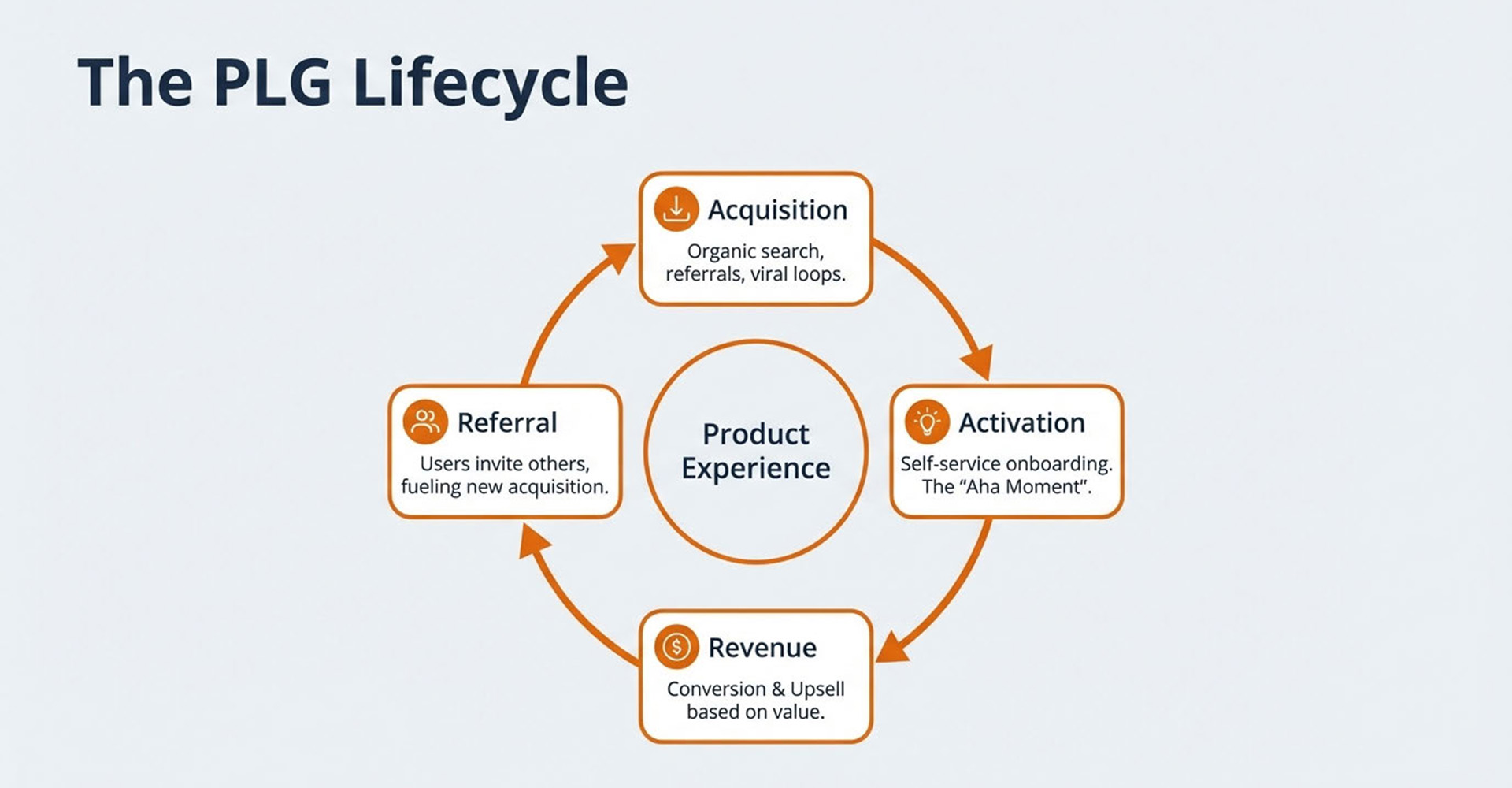
The PLG model places the product at the center of the entire customer lifecycle. Here’s how each stage functions.
Product as the Primary Acquisition Channel
Users discover and sign up directly through organic search, referrals, or viral exposure from existing users. Traditional sales outreach plays a secondary role, if any.
Self Service Onboarding and Activation
Activation is the moment a user experiences core value—often called the “aha moment.” PLG products guide users to this moment without human intervention through in-app tutorials, tooltips, and progressive feature introduction.

Usage Driven Expansion and Upsells
As users derive more value, they naturally hit usage limits or discover premium features, prompting upgrades. This expansion is driven by engagement rather than sales pressure.
Product Qualified Leads for Sales Engagement
A Product Qualified Lead (PQL) is a user demonstrating buying intent through in-product behavior. Sales teams focus on PQLs identified by usage signals—like hitting usage limits or inviting many team members—rather than pursuing cold outreach.
PLG Pricing Models for SaaS Companies
What pricing models support a product-led growth strategy?
PLG requires pricing that enables self-service adoption and creates natural expansion pathways.
| Pricing Model | How it Works | Best For |
|---|---|---|
| Freemium | Free tier with paid upgrades | High-volume user acquisition |
| Free Trial | Time-limited full access | Products with quick time-to-value |
| Usage-Based | Pay per consumption | Variable usage patterns |
| Hybrid | Base fee plus usage | Revenue predictability with expansion |
Freemium Pricing
A freemium model offers a free-forever tier with limited features or usage. Users upgrade when they hit limits or require advanced capabilities. The free tier serves as a permanent acquisition channel.
Free Trial Pricing
A free trial provides full access for a limited time, typically 7 to 30 days. Users convert to paid before the trial closes. Unlike freemium, the limitation is time rather than features.

Usage Based Pricing
With usage-based pricing, customers pay based on consumption—API calls, storage, transactions, or compute time. This aligns cost with value and facilitates land-and-expand motions as usage grows.
Hybrid Subscription and Consumption Pricing
A hybrid model combines a base subscription fee with usage-based components. 61% of SaaS companies now employ hybrid pricing, providing predictable recurring revenue while allowing revenue to grow as consumption increases.
How to Implement a Product Led Growth Strategy
How do you transition to or build a product-led growth strategy?
Implementing PLG involves aligning your product, pricing, and teams around the user experience. The following steps outline a typical implementation path.
- Define Your Ideal User and Time to Value
Identify the user persona that gets value fastest. Map the shortest path for that user to reach their “aha moment”—the point where they understand why the product matters.
- Build Self Service Product Experiences
Remove friction from signup, onboarding, and core workflows. Users can experience core value without talking to anyone or waiting for implementation.
- Implement Product Analytics and Instrumentation
Track user behavior to understand activation, engagement, and conversion patterns. This data drives PLG optimization and identifies where users drop off.

4. Design Pricing That Drives Conversion and Expansion
Pricing aligns with how users discover value. Easy entry points for new users and natural upgrade paths encourage organic expansion.
- Align Sales and Customer Success with Product Signals
Sales shifts from outbound prospecting to responding to PQLs. Customer success engages proactively based on usage patterns to prevent churn and identify expansion opportunities.
- Automate Billing and Revenue Operations
Self-service purchasing requires automated subscription management, usage-based billing, and seamless payment collection. Manual processes cannot scale with PLG transaction volumes.
How to Measure PLG Success
What metrics do PLG companies track?
PLG requires different KPIs than sales-led models, with a focus on product engagement and self-service conversion.
- Viral coefficient: New users generated per existing user
- Activation rate: Percentage of signups reaching core value
- Free-to-paid conversion: Percentage upgrading from free tier or trial
- Time to value: Duration from signup to activation
- Product qualified leads (PQLs): Users showing buying signals through behavior
- Net dollar retention: Revenue retained plus expansion from existing customers
- ARR/MRR: Annual and Monthly Recurring Revenue broken down by new, expansion, contraction, and churn

Product Led vs Sales Led Growth
What is the difference between product-led and sales-led growth?
The two approaches differ fundamentally in how customers move through the buying journey.
| Factor | Product-Led Growth | Sales-Led Growth |
|---|---|---|
| Primary driver | Product experience | Sales team |
| Acquisition | Self-service signup | Marketing plus sales outreach |
| Conversion | In-product upgrade | Sales negotiation |
| Typical deal size | Lower initial, expands over time | Higher initial contract |
| Scalability | Highly scalable | Linear with headcount |
| Best for | Quick time-to-value products | Complex enterprise solutions |
PLG works well for products with quick time-to-value and broad user appeal. Sales-led approaches suit complex, high-ACV (annual contract value) enterprise deals. Many companies successfully use a hybrid approach combining both, where self-service handles smaller accounts and sales engages enterprise opportunities.

How PLG Companies Scale with Automated Billing and Revenue Operations
Why is billing automation essential for scaling a product-led growth company?
PLG creates unique billing complexity: high transaction volumes, usage-based pricing, self-service upgrades, and frequent plan changes. Manual processes inevitably break down at PLG scale.
Consider a PLG company processing thousands of self-service signups monthly, each potentially upgrading, downgrading, or changing plans multiple times. Add usage-based components that require metering, rating, and invoicing, and the operational burden grows quickly.
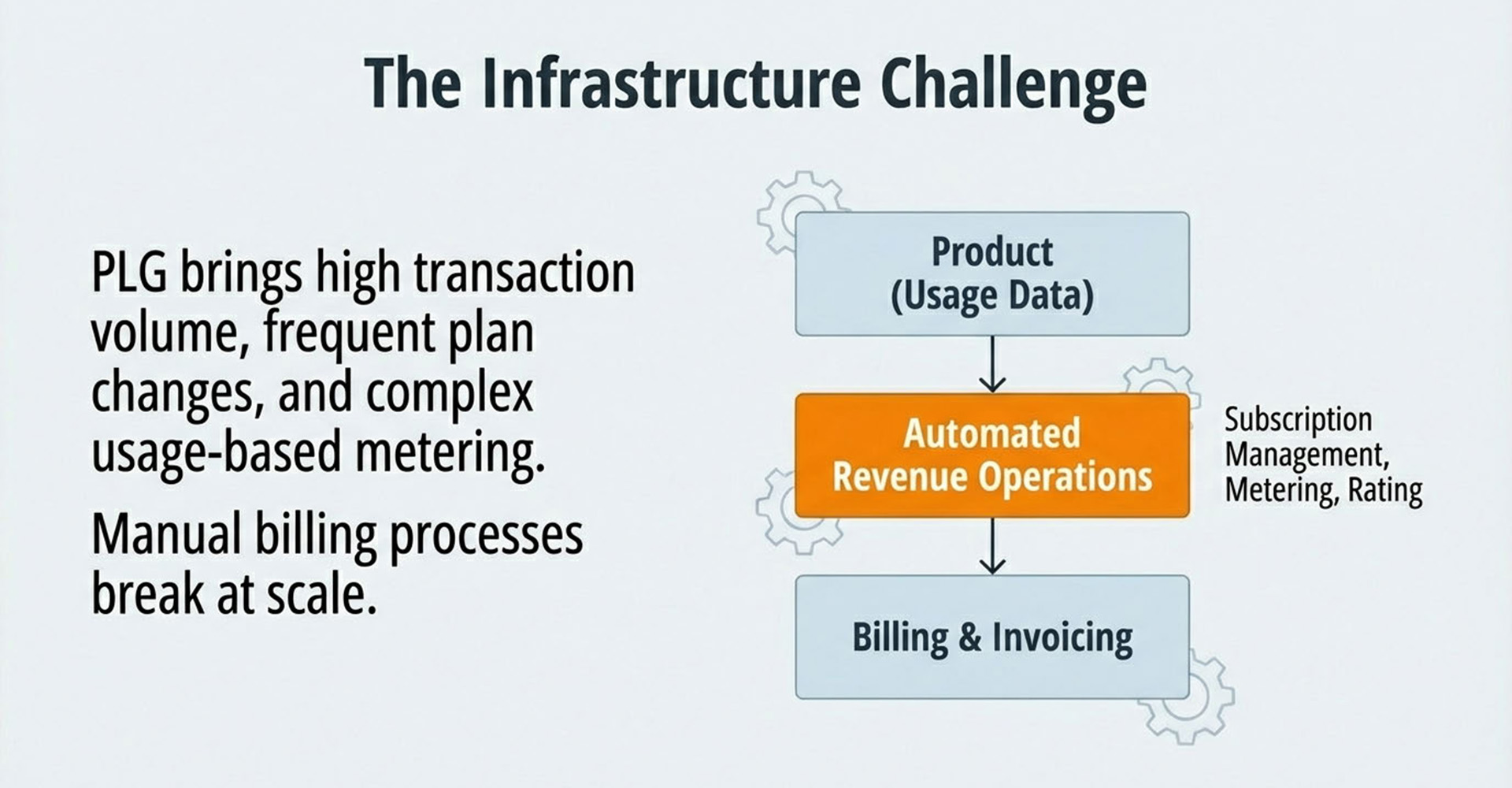
Automated subscription billing, usage-based billing, and revenue recognition enable PLG companies to scale efficiently without adding finance headcount. The billing infrastructure becomes as critical as the product itself.
Frequently Asked Questions
What is the difference between PLG and PLS?
PLG (Product-Led Growth) uses the product as the primary growth driver for all customers. PLS (Product-Led Sales) is a hybrid model combining self-service product experience with a sales team that engages larger accounts or users showing complex requirements.
What is PLG in marketing?
In marketing, PLG refers to strategies where the product serves as the primary marketing vehicle. Users experience value directly rather than being persuaded through traditional campaigns.
Which SaaS companies should use PLG?
PLG works well for products with quick time-to-value, broad user appeal, and natural viral or network effects. Complex enterprise products with long implementation cycles may benefit more from sales-led or hybrid approaches.
What are the biggest challenges with implementing PLG?
Common challenges include redesigning products for self-service, building adequate product analytics, aligning organizational incentives around product metrics, and scaling billing operations for high-volume transactions.