Struggling with Revenue Predictability? We analyze 8 key factors before you adopt. Master subscription billing and SaaS metrics for a stable 2026 strategy.


Stream, batch, or upload metered consumption data. Share pre-rated, partially rated, or unrated files. Process aggregate blocks or discrete units.

Compute charges for flat-rate, volume, tiered, and stair step billing models. Combine with flat-rate subscriptions, percentage billing, and one-time charges.

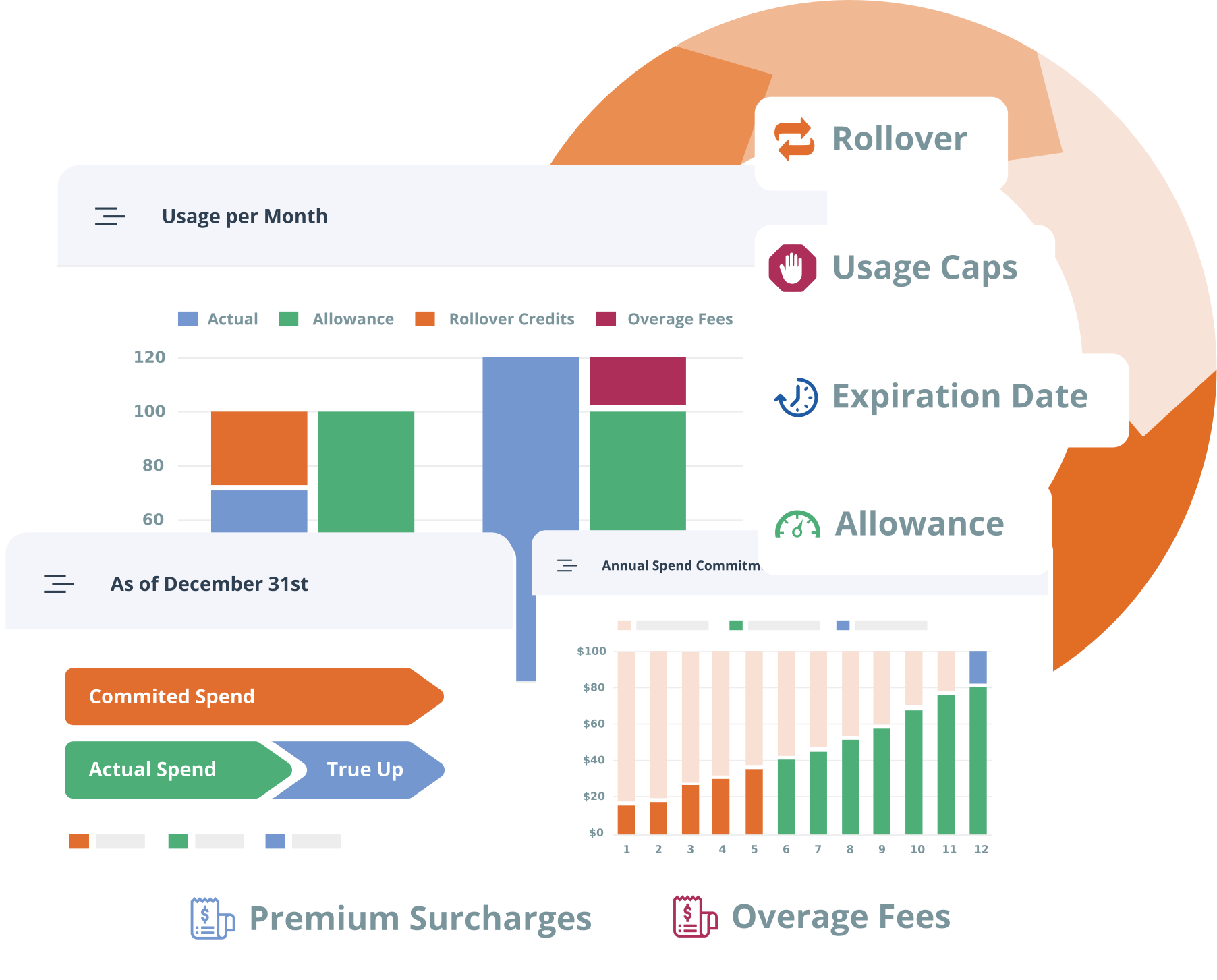
Calculate overage charges for excess usage above subscription allowances. Automate rollovers of credits and track expiration dates.

Manage drawdowns and replenishment of prepaid credits. Track progress towards contract spend commitments and calculate true-ups.

Display formulas, calculations, and rating tables for usage calculations on invoices. Enable downloads of usage detail records.
Ordway’s usage-based billing platform supports all the popular discounting models as well as hybrid combinations of usage, subscription, and transaction pricing.

Example: The customer is billed $0.50 per transaction whether they performed 1 transaction or 1 million transactions.

Example: The customer is billed if $1/unit if volume is below 1000. Above 1000, all units from 1 to n are billed at a discounted rate ($0.50).

Example: The customer is billed $1 for the first 1000 units consumed, $0.50 for the next 1000 units, and $0.25 for any additional units.

Example: Package A includes 500 units for $100/month. Customers of package A are billed $100/month whether they use 0, 250, or 500 units.


Get a Demo

Convert monthly, pay-as-you-go to annual contracts
With Ordway’s usage-based billing, you can offer customers discounts for signing annual capacity contracts with monthly minimums or prepaid credits.

Attract new customers with low risk and low cost entry point models that allow them to realize the value of your offering.

Convert month-to-month customers into long-term contracts with predictable revenue models that are more like recurring.

Grow customer revenues with enterprise contracts that allow multiple teams to use multiple products across the account.
With Ordway’s usage-based billing you can track:


Offer volume discounts to customers in exchange for spend commitments to incentivize greater adoption of usage-based products:
Track the aggregate spend (and usage) on eligible products on a quarterly, annual or contract term basis.
Calculate remaining balance based upon contract obligations and historical billings across various products and departments.
Determine amounts owed by customers for spend deficits. Perform true up calculations on monthly, quarterly, or annual basis.

Offer customers with lower consumption the flexibility to rollover credits to future periods. Monetize excess usage with overage charges.
Support pricing models with allowances for a certain number of units or transactions per month as part of a fixed fee package.
Manage rollover units along with the any associated usage caps, policies, and expiration dates.
Calculate charges for overages based upon pre-negotiated discounts, standard price lists, or by applying premium surcharges.


Reduce customer billing inquiries and disputes with more details on rating, calculations, and consumption
What types of usage-based pricing models does Ordway support?
Ordway supports a wide variety of billing metrics and units of measure, including time-based, transaction-based, volume-based, and count-based models, with native support for single-rate, volume, and tiered discounting. It accommodates pay-as-you-go, monthly plans, or longer-term annual contracts with prepaid usage, monthly minimums, or spend commitments, and can calculate billable usage quantities using methods like high water mark or percentile billing.
What is usage-based billing software?
Usage-based billing software generates invoices for customers based on the actual quantity of a product or service they consume. Charges are typically computed by multiplying the quantity of units consumed by a per-unit price, as exemplified by a cloud computing platform billing $1.00 per hour for 100 hours of service.
How does a usage-based billing platform work?
A usage-based billing platform works by metering customer consumption in real-time, then processing this data through a rating engine to compute charges based on billable quantity and appropriate per-unit price. The platform first determines the ‘billable usage quantity,’ factoring in free units, prepaid amounts, and minimums, and then applies the correct per-unit price according to contract terms and discounts to arrive at the line item charge, which is then incorporated into a detailed invoice for electronic distribution and payment.
How can I get the metered consumption data into Ordway’s billing software?
Metered consumption data can be imported into Ordway’s billing system through its user interface for small volumes, via a bulk CSV file upload utility, or by posting the data using its API. The API allows for streaming real-time data or batch uploading at regular frequencies, supporting individual usage records or bulk uploads, and also provides functionalities for updating, deleting, listing, and retrieving records.
Can Ordway perform revenue recognition for usage-based pricing models?
Yes, Ordway can automate much of the five-step process required for revenue recognition under ASC 606 (US GAAP) and IFRS 15 (international) standards. Most customers choose to recognize revenue based on actual invoiced amounts monthly, with journal entries created and posted to Ordway’s revenue sub-ledger, which can then publish summary journal entries to general ledgers like Quickbooks, Xero, Sage Intacct, and Oracle Netsuite.
See the industry’s most powerful usage-based billing software in action.
Struggling with Revenue Predictability? We analyze 8 key factors before you adopt. Master subscription billing and SaaS metrics for a stable 2026 strategy.
Discover the top challenges of usage-based pricing, from overage fees to zero-dollar invoices, and learn how to reduce customer inquiries.
Learn how Snowflake, DataDog, Fastly, and other public cloud companies calculate net revenue retention for usage-based pricing models. Compare the methodologies for the key retention metric.


© 2026 Ordway. All right reserved.Cookie PolicyPrivacy PolicyTerms & ConditionsPlatform StatusSite Map