TL;DR: General Ledger vs. Subledger
The General Ledger (GL) serves as your master accounting record, consolidating all financial transactions into high-level summary accounts. The Subledger, conversely, is the granular repository that tracks individual, transaction-level details (like specific customer invoices or vendor payments) before they are summarized and posted to the GL.
Key Takeaways
-
The Relationship: The GL is the “parent” (summary) and the subledger is the “child” (detail). The subledger provides the necessary backup documentation to support every control account balance in the GL.
-
The Purpose: Subledgers reduce clutter in the main GL, provide the operational detail needed for day-to-day management, and create the audit trail required to verify financial statements.
-
The Workflow: High-volume data (e.g., Accounts Receivable or Accounts Payable) originates in the subledger. Once recorded, the subledger feeds a summarized journal entry into the GL.
Best Practices for Management
-
Automate Data Flow: Avoid manual entry by using SaaS accounting software or Subscription Invoicing Software that automatically syncs transaction details to the subledger and posts summaries to the GL.
-
Integrate Systems: Connect your subledgers directly to your financial stack—including SaaS Billing, Metered Billing Software, and Recurring Billing Software—to ensure data integrity.
-
Reconcile Regularly: Perform reconciliation at period-end to ensure the subledger total matches the corresponding GL control account, identifying timing differences or errors quickly.
-
Maintain Audit Readiness: Keep full transaction history, timestamps, and user actions within the subledger to streamline the financial close and satisfy external auditor requirements.
The Bottom Line
A well-managed subledger system is the backbone of financial accuracy. It allows your business to scale by separating granular day-to-day transaction management from high-level financial reporting, ensuring that your general ledger remains clean, accurate, and audit-ready.
Are you currently using an automated system to reconcile your subledgers to the general ledger, or are you still relying on manual spreadsheets?
An accounting subledger is a detailed record that tracks individual transactions—such as customer invoices or vendor payments—before they are summarized and posted to the general ledger. It provides the granular backup behind every control account balance in your GL, maintaining the audit trail that proves your financial statements are accurate.
This guide covers how subledgers and the general ledger work together, the most common subledger types and how to reconcile them.
What is a General Ledger?
What is a general ledger and what role does it play in financial reporting?
The general ledger (GL) is the master accounting record that consolidates all financial transactions into summary-level accounts. It contains every account category a business tracks—assets, liabilities, equity, revenue, and expenses—and serves as the foundation for producing financial statements like the balance sheet and income statement.
Within the GL, you’ll find what accountants call control accounts. A control account is a summary-level account that represents the total balance of a related group of detailed transactions. For example, the “Accounts Receivable” control account in the GL shows the total amount customers owe, but it doesn’t show each individual invoice or payment.
The GL is where accountants, auditors, and finance leaders go to understand the company’s overall financial position. That said, the GL intentionally lacks granular detail—and that’s where subledgers come in.

What is an Accounting Subledger?
What is a subledger and why do finance teams use one?
An accounting subledger (also called a subsidiary ledger) is a detailed record that tracks specific transactions before they are summarized and posted to the general ledger. It provides granular, transaction-level data for a particular account category—such as individual customer invoices within accounts receivable—while reducing clutter in the main GL and ensuring detailed audit trails.
Think of the subledger as the backup documentation behind every summary number in your general ledger. When the GL shows $500,000 in accounts receivable, the AR subledger contains every invoice, payment, and credit memo that adds up to that total.
- Transaction-level detail: Each individual invoice, payment, or journal entry is recorded separately with full context
- Control account linkage: The subledger total always reconciles to its corresponding GL control account
- Audit trail: The subledger provides the supporting documentation auditors require to verify GL balances

General Ledger vs Subledger Key Differences
How does a subledger differ from a general ledger?
While both the general ledger and subledger are essential accounting records, they serve different purposes and operate at different levels of detail.
| Attribute | General Ledger | Subledger |
|---|---|---|
| Level of detail | Aggregated totals | Individual transactions |
| Transaction volume | Low (summary postings) | High (every transaction) |
| Primary purpose | Financial reporting | Operational tracking |
| Who uses it | CFO, auditors, investors | AR/AP clerks, controllers |
| Update frequency | Period-end or batch | Real-time or daily |
Level of transaction detail
The GL shows aggregated totals—for instance, the total accounts receivable balance across all customers. The subledger, on the other hand, shows every individual transaction: each customer invoice, each payment received, and each credit applied.
Volume and frequency of entries
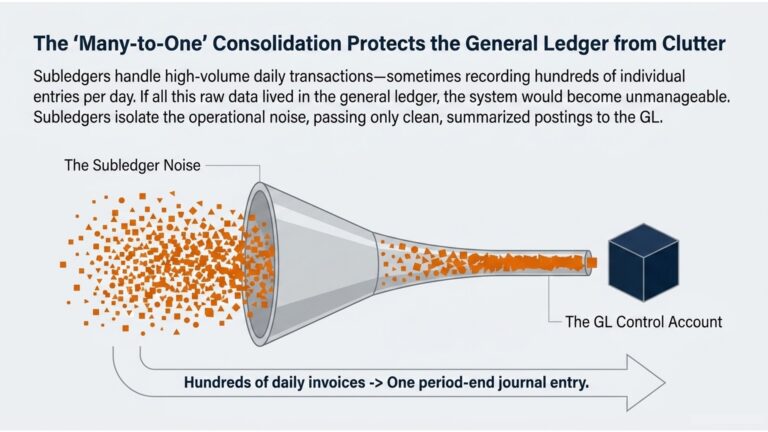
Subledgers handle high-volume daily transactions. A company might record hundreds of customer invoices per day in the AR subledger, while the GL receives only summarized postings—typically as journal entries at period-end or through automated sync.
Role in the financial close
The GL forms the basis for financial statements. Subledgers provide the backup detail that proves GL balances are accurate. During the close process, finance teams reconcile subledger totals to GL control accounts to confirm everything ties out.
Reporting and audit use
External financial reporting relies on the GL. Auditors, however, drill into subledgers to verify accuracy, trace individual transactions, and test controls. Without subledger detail, auditors would have no way to validate that GL balances are correct.

How Subledgers and the General Ledger Work Together
How do transactions flow from a subledger to the general ledger?
Subledgers and the general ledger operate in a parent-child relationship. The subledger captures every transaction in full detail, then posts a summarized journal entry to the corresponding GL control account.
- Step 1: A vendor invoice arrives for $10,000
- Step 2: The AP team records the invoice in the AP subledger with full detail—vendor name, invoice number, date, line items, and payment terms
- Step 3: The subledger posts a summarized journal entry to the GL: Debit Expense $10,000, Credit Accounts Payable $10,000
- Step 4: The GL reflects the updated AP balance, while the subledger retains the complete transaction record
This separation keeps the GL clean and manageable while preserving the granular data finance teams and auditors require.
Common Types of Accounting Subledgers
What are the most common subledgers used in accounting?
Most organizations maintain several subledgers based on transaction type and volume. The specific subledgers a company uses depend on its business model, though certain types appear in nearly every accounting system.
Accounts receivable subledger
The AR subledger tracks individual customer invoices, payments, credits, and balances. It enables aging analysis (30/60/90 days past due) and customer-level reporting, making it essential for collections and cash flow management.
Revenue subledger
The revenue subledger records recognized and deferred revenue by contract, performance obligation, or customer. For subscription and SaaS businesses, this is where revenue schedules live—separate from billing records. It’s critical for ASC 606 and IFRS 15 compliance, where companies track when revenue is earned versus when it’s billed. Ordway’s revenue recognition software includes a dedicated revenue subledger that automates compliance, generates recognition schedules, and integrates directly with your general ledger.

Accounts payable subledger
The AP subledger tracks individual vendor invoices, payments, and balances owed. It supports cash flow planning and vendor relationship management, ensuring the company pays the right amount to the right vendor at the right time.
Inventory subledger
The inventory subledger records quantities, costs, and movements of inventory items. It supports cost of goods sold calculations and stock management, tracking each purchase, sale, and adjustment.
Fixed assets subledger
The fixed assets subledger tracks individual assets, acquisition dates, depreciation schedules, and disposals. It’s essential for accurate depreciation expense calculations and asset valuations on the balance sheet.
Payroll subledger
The payroll subledger records employee compensation, deductions, taxes, and benefits by individual. It supports compliance with tax authorities and provides detailed labor cost analysis.
What a Subledger Journal Entry Looks Like
What does a typical subledger journal entry include?
A subledger journal entry captures far more detail than a standard GL entry. Let’s look at an example from an accounts receivable subledger when a company issues a customer invoice for $5,000.
- Transaction date: January 15, 2025
- Reference number: INV-2025-0042
- Customer name: Acme Corporation
- Description: Monthly subscription fee – Enterprise plan
- Debit amount: $5,000 (Accounts Receivable)
- Credit amount: $5,000 (Revenue)
- GL account mapping: AR Control Account #1200
This detailed entry then rolls up to a single line in the GL: “Debit: Accounts Receivable $5,000.” The GL doesn’t show the customer name, invoice number, or description—just the summary impact on the control account.

How to Reconcile a Subledger to the General Ledger
How do you ensure subledger balances match the general ledger?
Reconciliation is the process of verifying that the subledger total equals the GL control account balance. This step is critical for financial accuracy and audit readiness—if the two don’t match, something has gone wrong.
Pull the subledger and general ledger balances
Export or run reports showing the subledger total and the corresponding GL control account balance as of the same date. Timing matters: both reports need to reflect the same cutoff.
Match transaction detail to GL postings
Verify that individual subledger entries were correctly summarized and posted to the GL. Look for missing postings, duplicate entries, or transactions recorded in the wrong account.

Investigate and resolve variances
When the totals don’t match, identify the root cause. Common issues include timing differences (a transaction recorded in one system but not yet in the other), posting errors, or transactions recorded in the wrong period.
Post adjusting journal entries
Record corrections in either the subledger or GL to bring balances into agreement. Document the reason for each adjustment.
Document and sign off the reconciliation
Retain evidence of the reconciliation for audit trail purposes. Most organizations perform this process at each period-end close—monthly, quarterly, or annually.
Why Companies use Accounting Subledgers
What are the benefits of using subledgers in your accounting system?
Subledgers are essential for any organization with meaningful transaction volume. Here’s why finance teams rely on them:
- Detailed insights: Track specific vendor payments, customer invoices, and asset activity without cluttering the GL
- Improved accuracy: Separate detailed data entry from high-level reporting, reducing errors and making problems easier to spot
- Audit readiness: Provide the granular supporting documentation auditors require to verify GL balances
- Scalability: Organize growing transaction volumes into specialized categories that different teams can manage
- Compliance support: Maintain the transaction-level records required by standards like ASC 606 and IFRS 15

Best Practices for Managing Accounting Subledgers
How can finance teams manage subledgers effectively?
Well-managed subledgers reduce errors, accelerate the close, and keep auditors happy. Here are practices that high-performing finance teams follow.
Automate high-volume transaction posting
Use billing or accounting software to automatically record transactions in the subledger and post summaries to the GL. Manual entry is slow and error-prone, especially at scale.
Integrate subledgers with your ERP
Ensure subledger systems—including billing, revenue recognition, and AR—connect directly to the general ledger via native integrations. Ordway integrates with QuickBooks, NetSuite, Sage Intacct, and Xero to automate this data flow.
Maintain a clear audit trail
Retain full transaction history, timestamps, and user actions in the subledger. This documentation supports both internal controls and external audits.

Example of a Subledger – Revenue Subledgers for SaaS
How is a revenue subledger used for subscription businesses?
SaaS and subscription companies face a unique challenge: the timing of billing rarely matches the timing of revenue recognition. A customer might pay $12,000 upfront for an annual subscription, but the company recognizes $1,000 in revenue each month as the service is delivered.
- Deferred revenue: Revenue that has been billed but not yet earned
- Recognition schedules: Straight-line, exact-day, or custom recognition patterns applied per contract
- Contract modifications: Upgrades, downgrades, and renewals handled without manual rework
- Audit compliance: Transaction-level detail auditors require for revenue testing under ASC 606 and IFRS 15
Without a revenue subledger, subscription companies often resort to spreadsheets—a risky approach that doesn’t scale and creates audit headaches.

Frequently Asked Questions about Subledgers
The general ledger is your master accounting record that consolidates all financial transactions into high-level summary accounts, while the subledger tracks individual transaction-level details like specific customer invoices or vendor payments before they're summarized and posted to the GL.
Subledgers reduce clutter in the main GL, provide operational detail needed for day-to-day management, and create the audit trail required to verify financial statements and support every control account balance.
You should reconcile at period-end to ensure the subledger total matches the corresponding GL control account, which helps identify timing differences or errors quickly.
You should automate data flow using SaaS accounting software or subscription invoicing software that automatically syncs transaction details to the subledger and posts summaries to the GL, avoiding manual entry errors.