Our team is on a mission to help companies compete on a global scale through the Ordway platform. Today, I’m proud to announce our release of multi-entity billing and revenue management which means businesses can expand internationally with ease.
As your business grows, the last thing you want to worry about is if your finance stack will scale with you. I commissioned our team to leapfrog the limitations of legacy software and find solutions to multi-entity support that historically were only available to the Enterprise. Historically, only costly and clunky legacy ERP software could support multi-entity companies with their SaaS billing and accounting needs. This translated into manual workarounds and spreadsheets and hundreds of thousands spent on software fees and professional services, placing a drag on even the most nimble companies. Today, companies can run their business units independently and still unify subscription billing, revenue recognition, and investor metrics reporting within one system on the Ordway billing and revenue automation platform.
What Multi-Entity Support Means
Billing Unification
- Create unique invoice templates for each entity
- Assign products and plans to appropriate chart of accounts codes
- Configure local payment gateways based on local needs
- Set base currencies for each entity
- Revenue schedule unification and integration with the general ledger
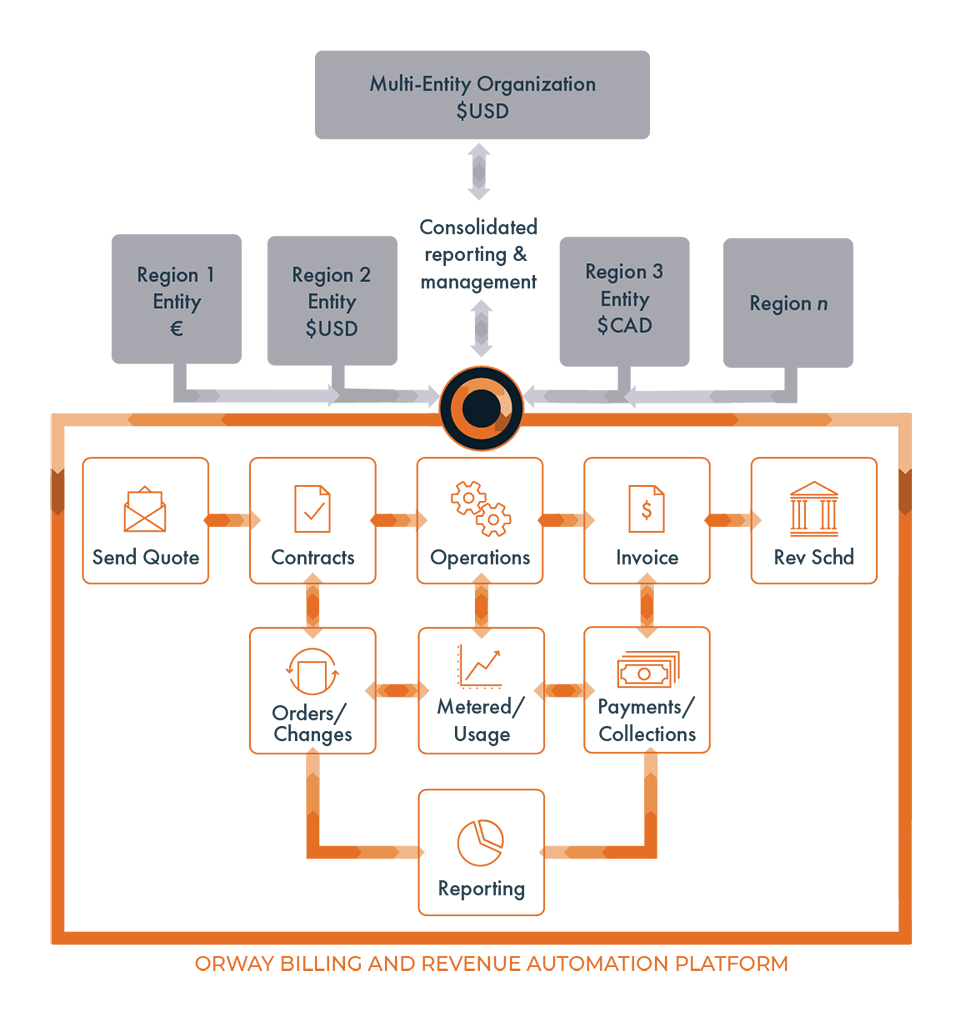
Revenue Schedule Unification and GL Integration
- Send summary journal entries monthly to your ERP or accounting software
- Revenue reporting unification
Revenue Reporting Unification
- Report revenue, product mix, customer growth across all child entities
- Rollup child accounts receivable data to see the overall health of individual or aggregate entities
Scale Revenue with International Expansion, Mergers and Acquisitions, and other Multi-Entity Use Cases
- Are you ready to establish multiple entities in 2021?
- How do you know if multi-entity billing and revenue management suits your needs? Consider the following questions:
- Do you have large portions of revenue coming from customers in different parts of the world?
- Do you struggle to manage your product portfolio across the regions you serve? How about revenue reporting?
- Are you compelled to establish entities to comply with local regulations and laws?
- Are you considering establishing a wholly owned subsidiary? A Joint Venture?
- Do you have different trading and reporting currencies?
- Has international expansion required that you begin billing customers in their local currencies?
If your business is scaling internationally, and want help thinking through these questions, contact Ordway to set up a demo. We’ll walk you through our automated billing and revenue management platform and show you how to make multi-entity work for you.
Frequently asked questions
Multi-entity revenue management lets businesses run independent business units while keeping subscription billing, revenue recognition, and investor reporting unified in a single system. It eliminates the need for manual workarounds and spreadsheets across separate entities.
Yes. Ordway's multi-entity billing lets you run business units independently while centralizing subscription billing, revenue recognition, and metrics reporting in one platform.
Multi-entity billing removes the friction of managing separate finance systems for different countries or business units, letting you expand globally without the complexity and cost of legacy ERP software.
Legacy ERP solutions historically cost hundreds of thousands in software fees and professional services. Ordway offers multi-entity support at a fraction of that cost without the complexity.