Summary
Navigating U.S. sales tax for SaaS is a significant challenge, as its taxability varies dramatically by state and customer location, not by federal mandate. This complex landscape requires SaaS companies to understand individual state classifications, nexus thresholds, and local jurisdiction rules. Our guide provides an essential roadmap to understanding SaaS taxability, ensuring compliance, and avoiding costly penalties in this ever-evolving regulatory environment.
Key Takeaways
- SaaS sales tax is state-dependent, with no uniform federal rule, leading to significant variations in taxability, rates, and filing requirements across jurisdictions.
- Understanding nexus—both physical and economic—is crucial for determining where your SaaS company has an obligation to collect sales tax.
- States classify SaaS differently, sometimes as tangible personal property, digital goods, or a service, which directly impacts its taxability status.
- Compliance involves a sequential process: determining nexus, registering for permits, configuring billing systems, and consistently filing and remitting taxes.
- Ignoring SaaS sales tax obligations can lead to severe financial penalties, audit exposure, and negatively impact business valuation during M&A.
Are SaaS Companies Assessed Sales Tax in the US?
SaaS sales tax is a consumption tax that some U.S. states apply to cloud-based software subscriptions—but whether your product is taxable depends entirely on where your customers are located. There is no federal sales tax in the US, so each state makes its own determination about how to classify and tax software delivered over the internet. This guide covers SaaS taxability by state, nexus thresholds that trigger collection obligations, local jurisdiction taxes, exemptions, compliance steps, and the penalties for getting it wrong.
What is SaaS Sales Tax?
SaaS sales tax is a consumption tax that some U.S. states apply to cloud-based software subscriptions. Unlike physical goods with clear taxability rules, SaaS sits in a gray area—delivered electronically, accessed remotely, and classified differently depending on which state your customer lives in.
The U.S. has no federal sales tax. Instead, each state decides independently whether SaaS is taxable, what rate applies, and under what conditions. As of 2026, 25 US jurisdictions tax some form of SaaS, though the specific rules vary significantly from one jurisdiction to the next. This patchwork creates real operational challenges. A SaaS company selling to customers in 20 states may face 20 different taxability determinations, rates, and filing requirements—all for the same product.

Is SaaS Taxable in the United States
Is software as a service taxable at the federal level? No. Taxability is determined entirely at the state and local level, which is why SaaS sales tax compliance gets complicated quickly.
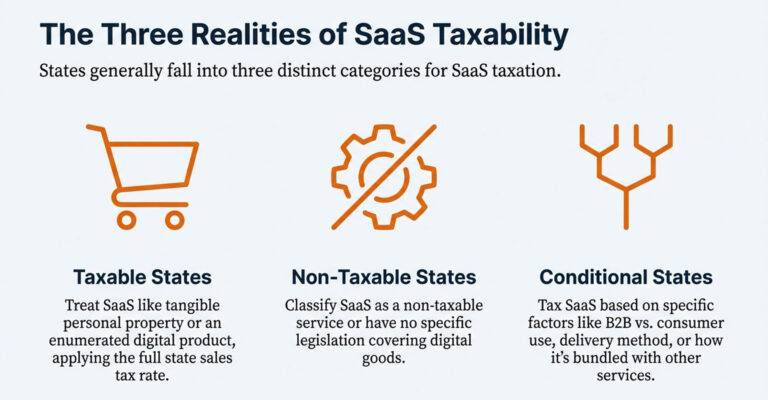
States generally fall into three categories:
- Taxable states: Treat SaaS like tangible personal property or enumerated digital products and apply the full state sales tax rate
- Non-taxable states: Classify SaaS as a non-taxable service or have not enacted legislation covering digital products
- Conditional states: Tax SaaS based on specific factors such as business versus consumer use, delivery method, or bundling with other services
Because of this variation, a SaaS company cannot assume uniform treatment across its customer base. Each state requires individual analysis.
What Qualifies as Software as a Service for Tax Purposes
How do tax authorities define SaaS? For tax purposes, SaaS generally refers to software accessed remotely via the internet without downloading or installing anything on local hardware. The customer uses the software through a browser while the vendor hosts and maintains the application on remote servers.
This definition matters because states often distinguish SaaS from other software categories:
- Canned (prewritten) software: Sold off-the-shelf without customization, often taxable in most states
- Custom software: Developed specifically for one customer, often exempt from sales tax
- Downloaded software: Transferred electronically but installed on the customer’s device
Some states only tax SaaS if it would be taxable as canned software. Others have created separate digital goods or data processing service categories that capture SaaS specifically.
SaaS Sales Tax Rates and Rules by State
Where is SaaS taxable by the state? This is the central question for most SaaS finance teams. The answer varies significantly and changes frequently as states update their digital tax laws.

States Where SaaS Is Fully Taxable
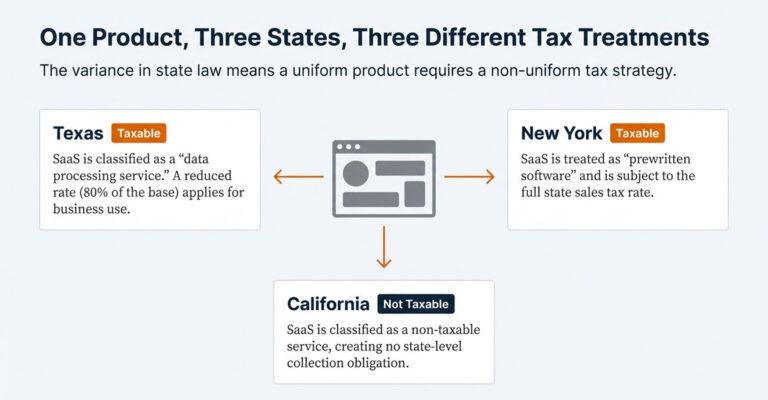
Several large states tax SaaS at the full state sales tax rate, including Texas, New York, Pennsylvania, Washington, Ohio, Massachusetts, and South Carolina. In these states, SaaS is typically classified as taxable tangible personal property, prewritten software, or enumerated digital goods.
If you have nexus in one of these states and sell SaaS to customers located there, you collect and remit sales tax on those transactions.
States Where SaaS Is Not Taxable
Other states exempt SaaS from sales tax entirely. California, Virginia, Florida, and Missouri are notable examples. These states either classify SaaS as a non-taxable service or have not enacted legislation extending sales tax to remotely accessed software.
However, “not taxable” at the state level does not always mean zero tax obligation. Some local jurisdictions within these states impose their own taxes on digital services.
States With Conditional SaaS Taxability
A third group of states applies conditional rules:
- Business vs. personal use: Texas taxes SaaS as a data processing service but applies a reduced rate when sold for business use. Connecticut similarly differentiates between consumer and business customers.
- Delivery method: Some states only tax SaaS if the customer downloads software to their device. Pure cloud-based access may be exempt.
- Bundling: When SaaS is bundled with other services, hardware, or support, the entire transaction may become taxable even if the SaaS component alone would be exempt.
What Is Sales Tax Nexus for SaaS Companies
What triggers a SaaS company’s obligation to collect sales tax? Nexus is the legal connection between a business and a state that creates a tax collection obligation. Without nexus in a particular state, a company has no requirement to collect that state’s sales tax—even if SaaS is taxable there.
Physical Nexus
Physical nexus exists when a company has a tangible presence in a state: employees working there, an office or warehouse, inventory stored there, or equipment located within state borders. For SaaS companies with distributed teams, a single employee working from home in a particular state can trigger physical nexus.
Economic Nexus
Economic nexus is established when a company exceeds revenue or transaction thresholds in a state, regardless of physical presence. This became the standard framework after the 2018 Supreme Court decision in South Dakota v. Wayfair, which has made expanding across the U.S. more difficult for 77% of midsize businesses. Most states have adopted economic nexus rules since then, with 15 states eliminating the 200-transaction threshold as of July 2025.

Local Jurisdiction Taxes on SaaS Products
Do cities and counties impose separate SaaS taxes? Beyond state-level taxes, some local jurisdictions impose additional taxes on SaaS products. This adds another layer of complexity because local rules may differ from state-level treatment.
Chicago Personal Property Lease Transaction Tax
Chicago imposes a 9% Personal Property Lease Transaction Tax on certain cloud-based services and SaaS products used by customers in the city. This tax applies regardless of where the vendor is located—what matters is the customer’s location.
Colorado Home Rule Cities
Colorado has dozens of home rule cities that administer their own sales tax independently from the state. Denver, for example, imposes a separate tax on SaaS. Companies may need to register and remit taxes to individual cities rather than through a single state filing.
Louisiana Parish-Level Tax Variability
Louisiana parishes set their own rates and rules, creating varying taxability for SaaS across the state. Some parishes may tax cloud-based software while others do not, even when the state-level treatment is unclear.

How to Collect and Remit SaaS Sales Tax
What steps does a SaaS company take to comply with sales tax requirements? Compliance involves a sequential process that begins with understanding where obligations exist and ends with timely filing and payment.
1. Determine Where You Have Nexus
First, identify all states where you have physical or economic nexus. This requires reviewing employee locations, sales volume by state, and transaction counts against each state’s thresholds.
2. Register for Sales Tax Permits
Next, register with each state’s tax authority before collecting tax. Collecting sales tax without a valid permit is illegal in most states and can result in penalties.
3. Configure Tax Collection in Your Billing System
Then, set up your billing system to calculate the correct tax rate based on customer location and product taxability.
Modern subscription billing platforms integrate with tax calculation services like Avalara or Anrok to automate this process.
4. File and Remit Sales Tax on Schedule
Finally, file returns and remit collected taxes by each state’s deadlines. Filing frequency—monthly, quarterly, or annually—depends on sales volume in each state.

Sales Tax Exemptions for SaaS Products
When can SaaS sales be exempt from sales tax? Even in states where SaaS is generally taxable, certain transactions may qualify for exemptions.
Business-to-Business Exemptions
Some states exempt SaaS sold to businesses for use in their operations, particularly when the software is used to produce goods or services for resale.
Resale Certificate Exemptions
Customers who purchase SaaS to resell—such as managed service providers or resellers—can provide resale certificates to purchase tax-free. Sellers collect and validate these certificates to support the exemption.
Nonprofit and Government Exemptions
Sales to qualified nonprofit organizations and government entities are often exempt. Sellers obtain and retain exemption certificates to document these transactions.

Penalties for Not Collecting SaaS Sales Tax
What happens if a SaaS company fails to collect required sales tax? Non-compliance exposes companies to financial and legal consequences that compound over time.
Back Taxes and Interest
States can assess uncollected taxes going back several years—lookback periods typically range from three to seven years. Interest accrues on unpaid amounts from the original due date.
Fines and Civil Penalties
States impose penalties for failure to file, failure to pay, and negligence. Penalties are generally around 30% of the underpaid sales tax or flat amounts per violation.
Audit Exposure and Liability
Non-compliant companies face higher audit risk. In an audit, the burden falls on the company to prove taxes were correctly collected and remitted.

How Sales Tax Compliance Affects SaaS Business Valuation
Why do investors and acquirers care about sales tax compliance? During due diligence for funding rounds or acquisitions, buyers assess sales tax exposure as a potential liability. Uncollected taxes can reduce purchase price or require escrow holdbacks.
- M&A due diligence: Buyers quantify potential tax liability across all states where the company has nexus
- Audit risk: Non-compliance discovered post-acquisition becomes the buyer’s problem
- Indemnification: Sellers may be required to indemnify buyers for historical tax exposure
For SaaS companies preparing for fundraising or exit, proactive compliance reduces friction and protects valuation.

Best Practices for SaaS Sales Tax Compliance
How can SaaS companies stay compliant as they scale? Several practices help companies manage the complexity of multi-state sales tax obligations:
- Monitor nexus continuously: Track sales by state to identify when thresholds are crossed
- Maintain exemption certificate records: Collect and organize certificates from exempt customers
- Audit your product taxability: Review how your SaaS products are classified in each jurisdiction
- Stay current on law changes: States frequently update SaaS tax rules
- Document your tax positions: Maintain written policies supporting your taxability determinations

How to Automate Sales Tax Collection for SaaS
What tools help SaaS companies automate sales tax? Manual compliance becomes unmanageable as companies scale across states. Automation addresses the key pain points.
Key capabilities of sales tax automation include:
- Real-time tax calculation: Determines correct rate based on product and customer location
- Nexus monitoring: Tracks sales volume by state against thresholds
- Filing and remittance: Prepares returns and submits payments
- Integration with billing: Ensures tax is calculated and applied on every invoice
Subscription billing platforms with native tax integrations streamline the process by connecting contract data, invoice generation, and tax calculation in a single workflow.

Simplify SaaS Billing and Tax Compliance with Ordway
Managing sales tax compliance alongside complex subscription billing creates operational burden for growing SaaS companies. Ordway’s subscription billing platform integrates with leading tax automation tools to calculate, collect, and report sales tax across jurisdictions.
- Pre-built integrations with Avalara and Anrok
- Support for multi-state and international tax requirements
- Automated invoice generation with accurate tax calculation
- Audit-ready records for compliance
Conclusion
Navigating the intricate landscape of SaaS sales tax in the U.S. is undeniably complex, demanding a meticulous, state-by-state approach. From deciphering nexus thresholds and varied taxability rules to managing local jurisdiction nuances and understanding exemptions, proactive compliance is not just a regulatory burden—it’s a strategic imperative. Companies that embrace a systematic approach, leveraging automation where possible, will not only mitigate audit risks and avoid hefty penalties but also safeguard their business valuation and ensure sustainable growth in a dynamic digital economy.
Frequently Asked Questions
How do SaaS companies handle sales tax on usage-based pricing?
There is no US federal sales tax for SaaS. Each state makes its own determination about how to classify and tax software delivered over the internet.
Is SaaS taxable in California?
California does not tax SaaS because it classifies cloud-based software as a non-taxable service rather than tangible personal property.
Is SaaS taxable in Texas?
Texas taxes SaaS as a taxable data processing service, though a reduced rate applies when sold for business use rather than personal use.
Is SaaS taxable in Ohio?
Ohio taxes SaaS as a computer service, making most cloud-based software subscriptions subject to the state’s sales tax.
Is SaaS taxable in Connecticut?
Connecticut taxes SaaS as a computer and data processing service subject to the state’s sales tax rate.
Is SaaS taxable in Wisconsin?
Wisconsin generally does not tax SaaS when the software is accessed remotely without any download or transfer to the customer.
Is SaaS taxable in Georgia?
Georgia does not tax SaaS because the state has not enacted legislation that treats remotely accessed software as taxable tangible personal property.
Is SaaS taxable in Arizona?
Arizona taxes SaaS under its transaction privilege tax when delivered to customers located in the state.