A subscription business model is one where customers pay a recurring fee—monthly, quarterly, or annually—for ongoing access to a product or service instead of making a one-time purchase. This approach powers everything from the software your team uses daily to the streaming services you watch at home.
The model has become dominant across industries because it works for both sides: businesses get predictable, forecastable revenue while customers get continuous value without large upfront costs. This guide covers how subscription models work, the different types and pricing strategies available, and the operational foundations required to build one successfully.
What is a Subscription Business Model?
What is a subscription business model and why has it become so common?
A subscription business model is one where customers pay a recurring fee—monthly, quarterly, or annually—for ongoing access to a product or service, rather than making a one-time purchase. This approach generates predictable revenue, builds long-term customer relationships, and has become the standard across SaaS, streaming media, and ecommerce.
The value flows both ways. Businesses get a steady, forecastable income stream they can plan around. Customers get continuous access without a large upfront cost. Unlike traditional sales where the relationship often ends at checkout, subscription businesses stay connected to their customers month after month.
You encounter this model constantly—from the software your team uses to the streaming services you watch at home. Netflix, Salesforce, and Dollar Shave Club all operate on variations of the same core idea.

How Subscription Business Models Work
How do subscription businesses actually generate recurring revenue?
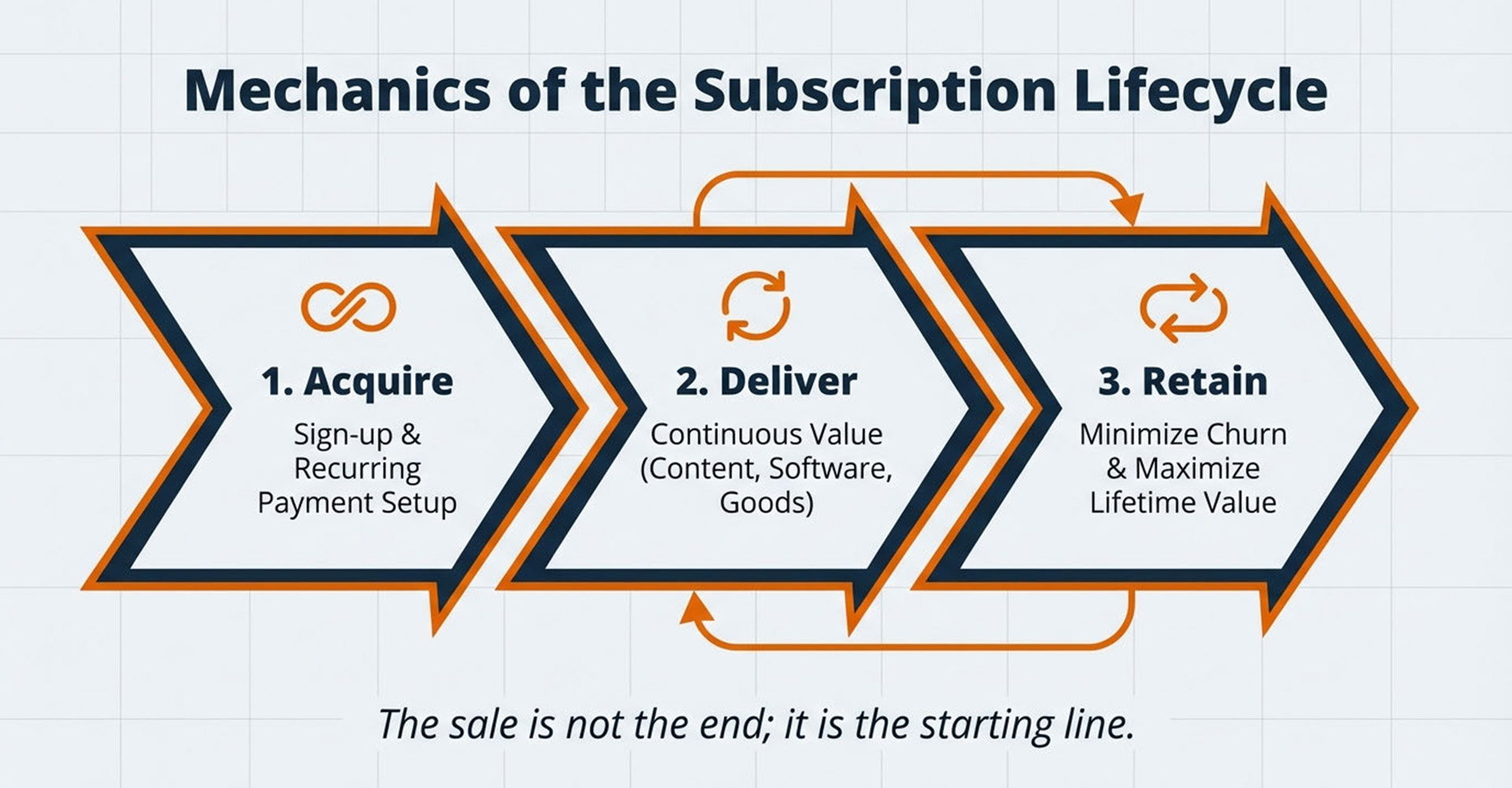
The subscription lifecycle has three stages: acquiring customers, delivering value continuously, and retaining those customers over time.
- Sign-up and recurring payment: A customer subscribes and provides payment details. The business then bills automatically on a set schedule without requiring manual action for each transaction.
- Continuous value delivery: The business provides the promised service, content, or products on an ongoing basis. Customers stay subscribed as long as they see enough value to justify the recurring charge.
- Retention focus: Long-term success depends on keeping churn (cancellations) low and maximizing customer lifetime value through engagement, support, and product improvement.
Running this model well requires systems for recurring billing, payment processing, and customer management. Manual processes tend to break down as subscriber counts grow.
Types of Subscription Business Models
What are the main types of subscription models?
Most subscription businesses fall into four categories, though many companies blend elements from multiple types.
Access Subscriptions
Customers pay for ongoing access to a service, platform, or content library. The value comes from availability, not ownership. Netflix (streaming video), Adobe Creative Cloud (software), and Amazon Prime (membership benefits) all follow this pattern.
Curation Subscriptions
Customers receive a curated selection of products delivered regularly. This model works well for discovery and personalization. Birchbox (beauty), Bokksu (snacks), and Book of the Month Club are common examples.
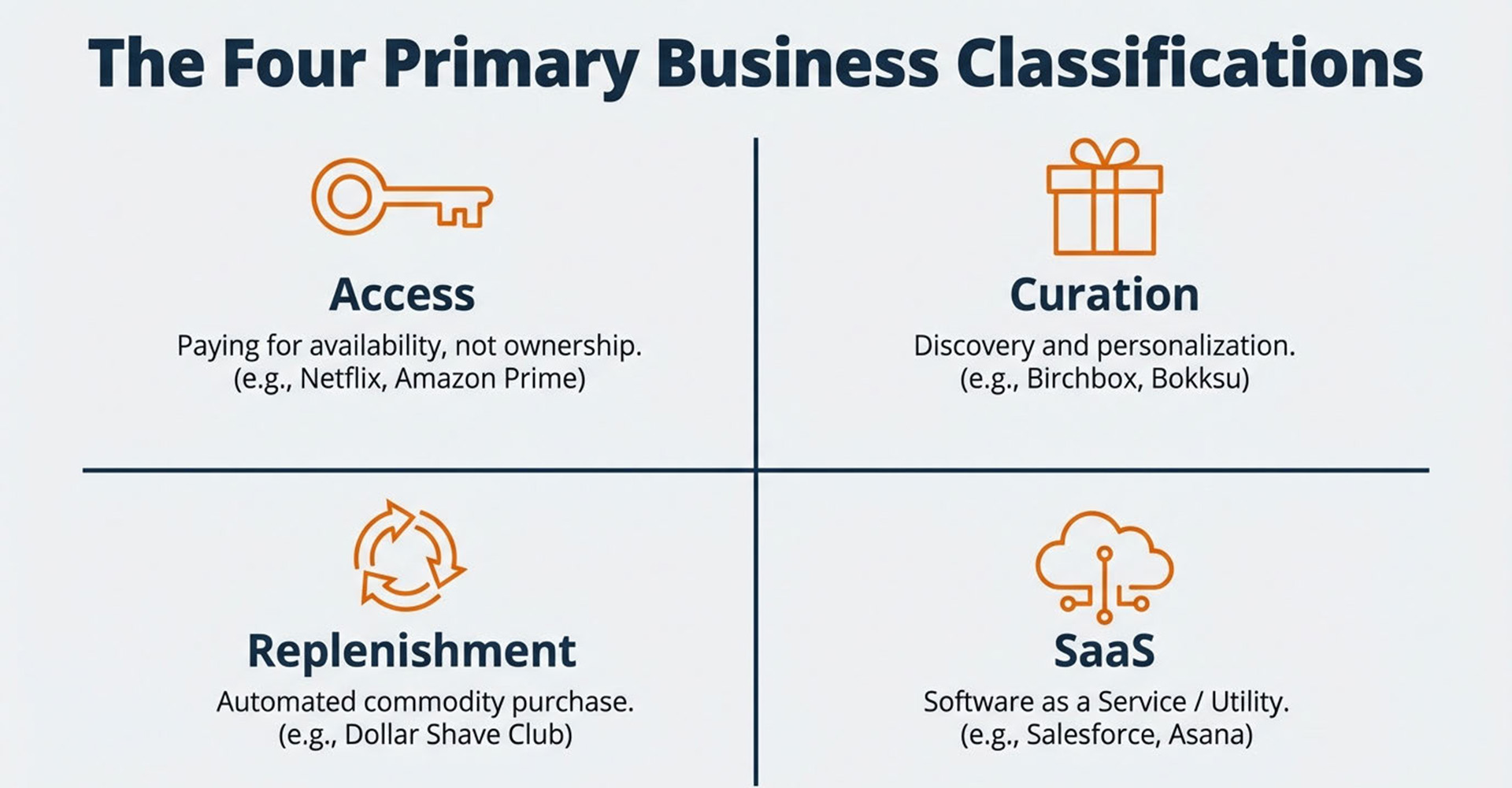
Replenishment Subscriptions
This model automates delivery of consumable goods customers use regularly. Dollar Shave Club (razors), Chewy (pet food), and Ritual (vitamins) save customers the hassle of remembering to reorder.
SaaS and Software Subscriptions
Software as a Service (SaaS) involves paying recurring fees to access applications hosted by the provider. This is the dominant model in B2B, with examples including Salesforce (CRM), Asana (project management), and billing platforms like Ordway.
Subscription Business Model Examples by Industry
What do successful subscription businesses look like across different industries?
A few concrete examples help illustrate how the model adapts to different contexts.
B2B SaaS and cloud platforms
B2B software fits naturally with subscriptions because providers deliver ongoing value through updates, support, and continuous improvement. Salesforce, NetSuite, and HubSpot are well-known examples.
Streaming and Digital Media Services
Content access models dominate here. Netflix and Hulu (video), Spotify and Apple Music (music), and The New York Times (news) all charge recurring fees for access to content libraries.

E-commerce Subscription Boxes
Curated product discovery has carved out a significant niche. Stitch Fix (personal styling), FabFitFun (lifestyle products), and Blue Apron (meal kits) deliver personalized selections on a regular schedule.
Consumer Subscription Services
Beyond media and boxes, subscriptions have expanded into fitness (Peloton), wellness (Headspace, Calm), and meal delivery (HelloFresh).
Why Subscription Models Work for Businesses
What advantages do subscription models offer over traditional one-time sales?
The shift toward subscriptions is driven by several concrete business benefits.
Predictable Recurring Revenue
The cornerstone of the subscription model is predictable revenue, typically measured as Monthly Recurring Revenue (MRR) and Annual Recurring Revenue (ARR). This stable income stream allows for more accurate financial forecasting compared to the “lumpy” revenue from one-time sales.
Higher Customer Lifetime Value
Ongoing relationships generate more total revenue per customer than single transactionsOngoing relationships generate more total revenue per customer than single transactions. McKinsey found subscription businesses achieve 2-5 times higher customer lifetime value compared to traditional models. Customer Lifetime Value (CLV) represents the total revenue expected from a customer account:
CLV = Average Revenue per Customer × Customer Lifespan
A customer paying $100/month who stays for 3 years generates $3,600 in CLV—far more than most one-time purchases would yield.
Stronger Customer Relationships
Recurring subscriptions create continuous touchpoints for engagement. This allows businesses to gather customer data, build feedback loops for product improvement, and identify opportunities for upselling.
Scalable Business Growth
Recurring revenue compounds over time. The marginal cost to serve an existing subscriber is typically much lower than acquiring a new one, which leads to more efficient growth as the business matures. Subscription businesses have historically grown 300% faster than S&P 500 companies from 2012-2018.
Disadvantages of Subscription-Based Business Models
What challenges do subscription businesses face?
The model comes with real operational complexities and financial risks.
High Customer Acquisition Costs
Subscription businesses often face substantial upfront Customer Acquisition Cost (CAC)Subscription businesses often face substantial upfront Customer Acquisition Cost (CAC), which have increased 222% over 8 years. Because revenue is collected over time, there’s a payback period before a customer becomes profitable.

Churn and Retention Risk
Churn—the rate at which customers cancel—can quickly erode revenue and negate growth from new customer acquisition. The churn rate formula is:According to the Recurly Churn Report, B2B SaaS companies average 3.5% churn, split between voluntary and involuntary cancellations. The churn rate formula is:
Churn Rate = Customers Lost ÷ Total Customers at Start of Period
If you start the month with 1,000 customers and lose 30, your monthly churn rate is 3%.
Billing and Operational Complexity
Recurring billing involves handling prorations for upgrades and downgrades, managing failed payments (dunning), issuing credits, and supporting various billing cycles. This complexity often requires dedicated billing automation.
Revenue Recognition Compliance
Accounting standards like ASC 606 and IFRS 15 require companies to recognize revenue as service is delivered, not when payment is collected. This creates complexities around deferred revenue that demand specialized systems.
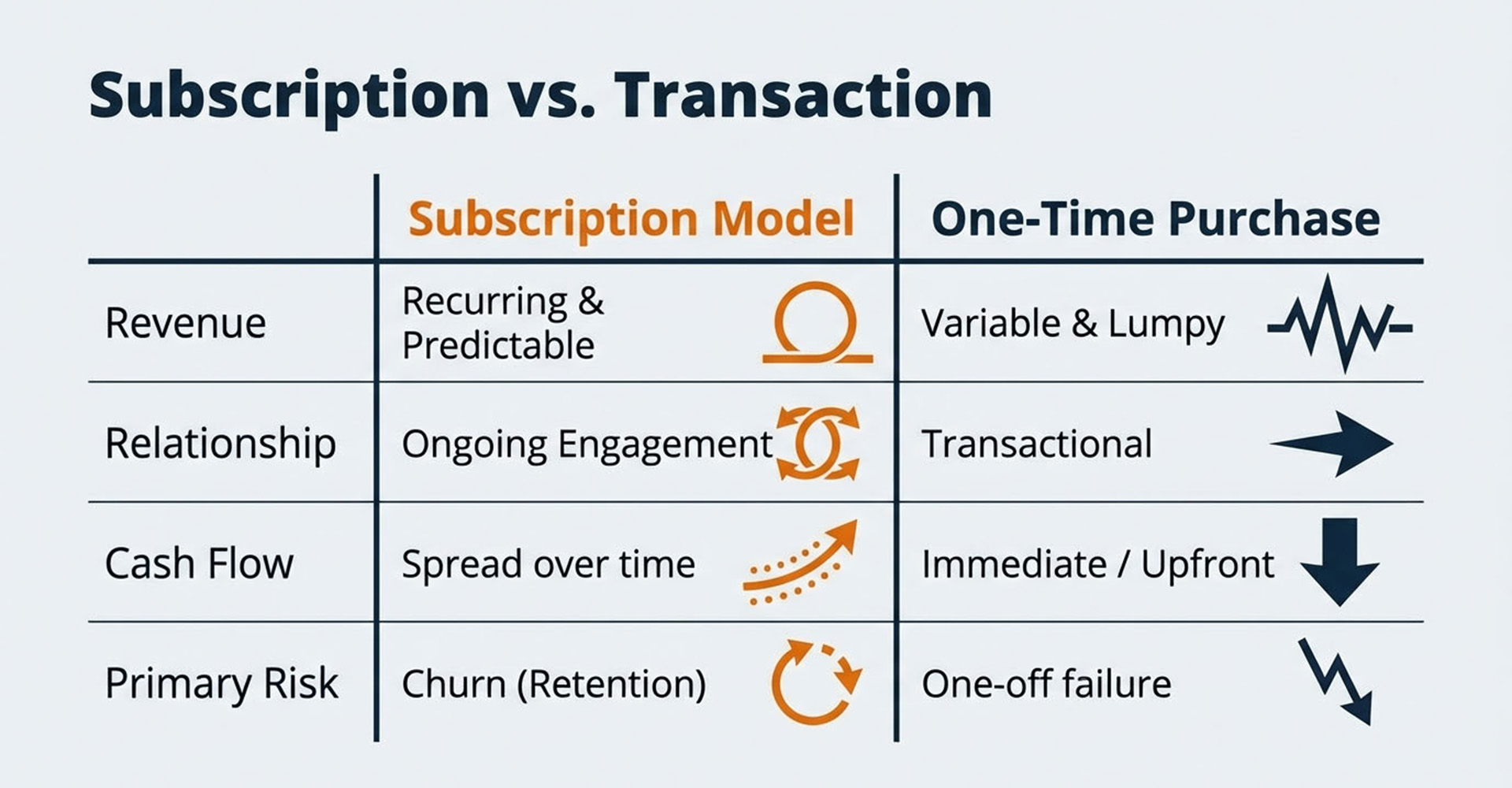
Subscription Models vs One-Time Payment Models
How do subscription models compare to traditional purchases?
The choice involves trade-offs between immediate cash flow and long-term value.
INSERT TABLE
One-time purchases work well for goods with long replacement cycles. Subscriptions fit better for services and products that provide continuous, evolving value.
Subscription Pricing Models
What pricing structures do subscription businesses use?
The pricing model determines how customers are charged.
Flat-Rate Pricing
One product, one set of features, one price. Simple to communicate, but doesn’t cater to different customer segments.
Tiered Pricing
Two or more packages with different features at different price points. This “good-better-best” structure is the most common approach in B2B SaaS.

Per-User Pricing
Charges based on the number of employees or “seats” using the product. Price scales directly with adoption within a company.
Usage-Based Pricing
Charges based on actual consumption—per API call, gigabyte stored, or transaction processed. Usage-based pricing models allow businesses to align costs directly with value delivered. Often combined with base subscriptions in hybrid models.
Freemium Pricing
A basic version is offered free, with the goal of converting users to paid premium features.
Subscription Strategies for Growth
What tactics help optimize pricing for growth?
Beyond the pricing structure, specific strategies can improve results.
Good-Better-Best Packaging
Three tiers serve different purposes: the lowest provides an entry point, the highest acts as a price anchor, and the middle tier captures most customers.
Annual Prepay Discounts
Discounts for annual commitments provide immediate cash flow and reduce churn risk since customers are locked in for a year.

Free Trials and Promotional Offers
Free trials let potential customers experience value firsthand before committing.
Hybrid Subscription and Usage Pricing
Combining stable base fees with variable usage charges gives businesses predictable revenue while capturing upside as customers grow their usage.
How to Start a Subscription-Based Business
What steps are involved in launching a subscription business?
Building a successful subscription business requires planning across several stages.
1) Validate Market Demand
Confirm customers actually want your product on an ongoing basis through interviews, research, and small-scale pilots.
2) Design Pricing and Packaging
Determine your pricing model and set price points based on customer willingness to pay.
3) Select Subscription Billing Software
Choose dedicated billing software that handles recurring invoicing, proration, payment retries, and revenue recognition.
4) Build Payment Collection Infrastructure
Integrate with a payment gateway and support the payment methods your customers prefer.
5) Launch and Acquire Subscribers
Develop your go-to-market strategy, whether product-led (self-service sign-up) or sales-led.
6) Measure Performance and Optimize
Track key metrics continuously to understand business health and identify improvement areas.
Key Metrics for Subscription Businesses
What metrics do subscription businesses track?
A few KPIs are essential for understanding performance.
Monthly Recurring Revenue and Annual Recurring Revenue
MRR and ARR represent predictable revenue expected every month or year:
• MRR = Sum of all monthly subscription revenue
• ARR = MRR × 12
If you have 100 customers paying $50/month, your MRR is $5,000 and your ARR is $60,000.
Customer churn rate
Churn measures the percentage of customers who cancel in a given period.

Net Dollar Retention
Net Dollar Retention (NDR) measures revenue growth from existing customers:
NDR = (Starting MRR + Expansion – Contraction – Churn) ÷ Starting MRR
NDR above 100% indicates growth from existing customers outpaces losses.
Customer Lifetime Value
CLV represents total expected revenue from a customer:
CLV = Average Revenue per Account ÷ Churn Rate
If your average customer pays $100/month and monthly churn is 2%, CLV equals $100 ÷ 0.02 = $5,000.
Best Practices for Subscription Business Success
What practices help subscription businesses thrive?
Successful subscription businesses share common operational approaches.
- Focus on customer success: Proactively engage with customers to ensure they’re getting value and maintaining strong revenue retention.
- Automate billing operations: Manual billing processes are error-prone and don’t scale.
- Implement dunning automation: Automatically retry failed payments to recover otherwise-lost revenue.
- Track metrics rigorously: Monitor key metrics in real-time to drive decisions.
- Iterate on pricing: Regularly evaluate pricing to ensure alignment with delivered value.

How Subscription Billing Automation Supports Recurring Revenue Growth
How does billing automation help subscription businesses scale?
As subscription businesses grow, manual processes for billing, collections, and revenue recognition become unsustainable.
Billing automation addresses these challenges by automating the order-to-revenue lifecycle. Platforms like Ordway handle complex recurring and hybrid pricing models, accurately rate and invoice usage-based charges, automate ASC 606/IFRS 15 compliance, and provide visibility into KPIs like ARR, NRR, and churn.
Learn more about Subscription Management and Billing Software
Frequently Asked Questions
How do subscription companies make money?
Subscription companies generate revenue through recurring payments from customers who pay monthly, quarterly, or annually for ongoing access. Profitability depends on acquiring customers at a cost lower than their total lifetime value.
Is a subscription business model profitable?
Subscription models can be highly profitable once a company achieves sufficient scale and maintains healthy retention. Recurring revenue compounds over time, and the marginal cost to serve existing customers is typically lower than acquiring new ones.
What is the difference between a subscription and a membership?
A subscription typically provides access to a product or service for a recurring fee, while a membership often includes community benefits or exclusive perks beyond product access. The terms are frequently used interchangeably.
What the different categories of subscription business models?
The three main types are access subscriptions (paying for ongoing access like Netflix), curation subscriptions (receiving curated products like Stitch Fix), and replenishment subscriptions (automatic delivery of consumables like Dollar Shave Club).
What types of billing software do subscription businesses need?
Subscription businesses benefit from specialized billing software supporting recurring invoicing, multiple pricing models, proration for mid-cycle changes, automated payment collection, and dunning for failed payments.